|
Chapter 21: Jesus the Galilean from Nazareth – the King of the Jews!
From the Galilee to the Cross and from the Cross to the Galilee
Even before Christ was crucified, He told His Disciples that He would go ahead of them and meet them in Galilee after His resurrection (Mark 14:28). Then after His resurrection, the angel at the tomb told the women who came to visit Christ’s tomb that Christ was not there, that He had risen, to go quickly and tell His disciples that Jesus was going ahead of them to Galilee – that they would see Christ there, just as He told them before He died (Matthew 28:10; Mark 16:7). As the women went to tell the Disciples what the angel told them, Jesus met them and repeated the message: “Don’t be afraid! Go tell My brothers to leave for Galilee, and they will see Me there” (Matthew 28:5-10).
Isaiah’s Prophecy: Isaiah 9:1-2
Galilee was a Fulfillment of Isaiah’s Prophecy: Christ sent word to His Disciples to meet Him in Galilee that the Scriptures might be fulfilled.
Seven hundred years before Christ was born the Prophet Isaiah Prophesied that the identity and mission of Christ were, according to God’s will, linked with the geographical area of Galilee – specifically the “Borderlands” of the Galilee of the Gentiles in Upper Galilee – the land of Zebulun and the land of Naphtali that God had held in contempt.
Isaiah 9:1-2 1 But there will be no more gloom for her who was in anguish [for with judgment comes the promise of salvation]. In earlier times He treated the land of Zebulun and the land of Naphtali with contempt, but later on He will make them honored [by the presence of the Messiah], by the way of the sea, on the other side of Jordan, Galilee of the Gentiles.
2 The people who walk in [spiritual] darkness Will see a great Light; The Light will shine on them. Amplified Bible
The Galilee was where the multitudes that were walking in spiritual darkness were set free by Christ, the Light of the World that leads to life. The multitudes came to see the Great and Glorious Light of the great “I AM” and were among the first to see that Great and Glorious Light that the Prophet Isaiah spoke of. Isaiah 9:1-2; Matthew 28:10; Mark 14:28; John 8:12
Among those living in the Galilee and the Borderlands of Galilee of the Gentiles that God had held in Contempt came the Promise of Salvation.
And, the Apostle Matthew, a Galilean echoes Isaiah’s Prophecy.
Jesus Begins His Ministry in Galilee
Jesus left for the Galilee and began His Ministry in the regions of the Galilee (Matthew 4:12-16) after His Victory over Satan and John the Baptist had been arrested.
Matthew 4: 8-17 8 Again, the devil took Him up on a very high mountain and showed Him all the kingdoms of the world and the glory [splendor, magnificence, and excellence] of them; 9 and he said to Him, “All these things I will give You, if You fall down and worship me.” 10 Then Jesus said to him, “Go away, Satan! For it is written and forever remains written, ‘You shall worship the Lord your God, and serve Him only.’” 11 Then the devil left Him; and angels came and ministered to Him [bringing Him food and serving Him].
12 Now when Jesus heard that John [the Baptist] had been arrested and put in prison, He left for Galilee. 13 And leaving Nazareth, He went and settled in Capernaum, which is by the sea, in the country of Zebulun and Naphtali. 14 This was to fulfill what was spoken by the prophet Isaiah:
15 “The land of Zebulun and the land of Naphtali, By the way of the sea, beyond the Jordan, Galilee [in the district] of the Gentiles—
17 From that time Jesus began to preach and say, “Repent [change your inner self—your old way of thinking, regret past sins, live your life in a way that proves repentance; seek God’s purpose for your life], for the kingdom of heaven is at hand. Amplified Bible
In this passage Matthew confirms that Jesus of Nazareth is the long awaited Messiah, the Son of God whose light would dispel the darkness of those living in the land of Zebulun and the land of Naphtali, the Galilee and the Galilee of the Gentiles that the Prophet Isaiah spoke of. The mention of “Galilee of the Gentiles” highlights the fact that the Gospel message is not just for the Jewish people, but is for the Gentiles as well.
At the time Herod had John the Baptist arrested and put in prison, all of Israel was under the rule of the Roman Government, and as their representative, Herod was appointed by the Roman emperor Caesar Augustus as Tetrarch over Galilee and the Galilee of the Gentiles. And, he ruled over the Galilee throughout Jesus of Nazareth’s ministry, and even conspired with Pilate, the Jews, and the gentiles to crucify Christ. Luke 3:1, Acts 4:27
Acts 4:27 27 For in this city there were gathered together against Your holy Servant Jesus, whom You anointed, both Herod and Pontius Pilate, along with the Gentiles and the peoples of Israel, Amplified Bible
Yet, and it is ironic, the regions of the Galilee where Christ would begin His ministry was the province of Herod, who had just arrested and imprisoned John. Herod may have silenced John, but he was unable to silence John’s message. John the Baptist, who came to prepare the “Way for the Lord,” said that Jesus must increase and that he himself must decrease John 3:30.
Luke 3:1-6 1Now in the fifteenth year of [Emperor] Tiberius Caesar’s reign—when Pontius Pilate was governor of Judea, and Herod [Antipas] was tetrarch of Galilee, and his brother Philip was tetrarch of the region of Ituraea and Trachonitis, and Lysanias was tetrarch of Abilene— 2 in the high priesthood of Annas and Caiaphas [his son-in-law], the word of God came to John, the son of Zacharias, in the wilderness. 3 And he went into all the country around the Jordan, preaching a baptism of repentance for the forgiveness of sin; 4 as it is written and forever remains written in the book of the words of Isaiah the prophet,
“The voice of one shouting in the wilderness, Prepare the way of the Lord, Make His paths straight.
5 ‘Every ravine shall be filled up, 6 and all mankind shall see the salvation of God.’” Amplified Bible
It was only after Jesus’ Victory over Satan that the ministry of John the Baptist to prepare the way for the Lord came to an end – his work here on earth was done. John the Baptist had prepared the way for the Lord and now Christ was ready to begin His ministry by withdrawing into the Galilee, into territory under the domain of Herod, to continue the work already begun by John the Baptist. And like John the Baptist, Jesus went into the Galilee preaching, “Repent, for the Kingdom of Heaven is at hand.” Matthew 3:-3 and Matthew 4:12-17
Not only did Isaiah prophesy that those living in the darkness of the Galilee would be the first to see the great light of the Messiah – Isaiah also prophesied that “The Voice of one Crying in the Wilderness would be sent to “Prepare the way of the Lord” Isaiah 40:3.
And, once again we find the Apostle Matthew, a Galilean, echoing Isaiah’s Prophecy who tells us that it was John the Baptist that Isaiah was speaking of 700 years before John was even born:
Matthew 3:1-3 1 In those days John the Baptist came preaching in the wilderness of Judea, 2 and saying, "Repent, for the kingdom of heaven is at hand!" 3 For this is he who was spoken of by the prophet Isaiah, saying:
"The voice of one crying in the wilderness: 'Prepare the way of the LORD; Make His paths straight.' " NKJV
In fulfillment of Isaiah’s prophecy that those in the regions of the Galilee and Galilee of the Gentiles who dwelt in darkness would see a Great Light – Jesus Christ, who said “I AM the Light of the World,” went into the regions of the Galilee and continued the ministry of John, who had come to prepare the way for Christ and brought light to the regions of Galilee where people were walking in spiritual darkness.
Jesus departed into Galilee where He had already spent the first thirty years of His life. From that point in time Jesus began to preach, and to say, “Repent for the Kingdom of Heaven is at hand.” And, it was here in the Galilee that Jesus called eleven of His Disciples – all Galileans. Only Judas was from Judea. And, as Jesus traveled throughout the regions of the Galilee, the great and glorious Light of Christ dispelled the spiritual darkness the Galileans were living in ever since the Assyrian Invasion that brought the Northern Kingdom of Israel to an end.
As Christ travelled throughout the Galilee He taught in the synagogues, performed miracles, healed the people of their diseases, and cast out demons, thus setting the Galileans free of the spiritual darkness and shadow of death that hovered over them, not only due to the Assyrian Invasion that brought the Northern Kingdom of Israel to an end, but also the idolatry of their forefathers that paved the way for the Assyrian Invasion. In essence, they were walking in the darkness of the sins of their forefathers.
Yet, there was hope. With the arrival of Christ, the Galilee was no longer a land of spiritual darkness. As prophesied by the Prophet Isaiah (Isaiah 9:1-2), the great Light of the World was finally shining in the Galilee and had dispelled the spiritual darkness. The great Light of the World was shining in the territory of the Galilee under the domain of Herod who had John the Baptist beheaded, and along with Pilate, the Jews, and the Gentiles, had conspired to crucify Christ.
Acts 4:27 27 For in this city there actually met and plotted together against Your holy Child and Servant Jesus, Whom You consecrated by anointing, both Herod and Pontius Pilate with the Gentiles and peoples of Israel, Amplified Bible, Classic Edition
However, Herod could not kill Christ.
And, that was the message that Christ wanted to convey to the Pharisees and Herod when Jesus told the Pharisees, “Go and tell Herod that Fox:”
Luke 13:31-35 31 At that very hour some Pharisees came up and said to Him, Go away from here, for Herod is determined to kill You.
32 And He said to them, Go and tell that fox [sly and crafty, skulking and cowardly], Behold, I drive out demons and perform healings today and tomorrow, and on the third day I finish (complete) My course. 33 Nevertheless, I must continue on My way today and tomorrow and the day after that—for it will never do for a prophet to be destroyed away from Jerusalem!
34 O Jerusalem, Jerusalem, you who continue to kill the prophets and to stone those who are sent to you! How often I have desired and yearned to gather your children together [around Me], as a hen [gathers] her young under her wings, but you would not!
35 Behold, your house is forsaken (abandoned, left to you destitute of God’s help)! And I tell you, you will not see Me again until the time comes when you shall say, Blessed (to be celebrated with praises) is He Who comes in the name of the Lord! Amplified Bible, Classic Edition
The Pharisees were suggesting that, just as Herod killed John the Baptist, Christ’s life was in danger now that Christ was living in Galilee within Herod’s jurisdiction (verse 31).
Which begs the question: Were the Pharisees hoping that Christ, out of fear of Herod, would leave the Galilee and come to Judea where He would come under the same jurisdiction they were under – the jurisdiction of Pilate? If Christ came under the jurisdiction of Pilate, then that meant the Pharisees, who also wanted to kill Jesus, would have the opportunity to bring charges against Christ not only of being a false prophet, but also that Jesus was challenging the Kingship of Caesar, which would almost certainly result in Pilate ordering His crucifixion. Both Herod and the Pharisees raged and plotted against Christ (Psalm 2 and Acts 4:27), but it was as King David prophesied, they did so in vain. However, Christ feared neither the rage of Herod nor of the Pharisees.
For if Herod, the Pharisees, and the rulers, as well as the Jews and Gentiles who wanted Christ crucified, had been willing to examine the claims of Jesus of Nazareth, that He would raise from the dead, they would have understood how futile their plot to crucify Jesus was – and the rulers of this world would never have crucified Christ 1Corinthians 2:6-8. If they had examined the evidence, they would have realized that they would never be able to keep Christ in the grave. However, they were unwilling to examine the evidence that Christ was the Son of God. They were unwilling to believe, each because of their own selfish agenda.
Christ knew that Herod could do Him no harm, not only because His time had not yet come, but also because the place appointed for His death was Jerusalem, which was not within Herod’s jurisdiction. Christ knew that if a true prophet was put to death, he had to be prosecuted as a false prophet, and this fell under the umbrella of the Sanhedrin, which only convened in Jerusalem. And that’s why the Pharisees wanted Jesus to leave Herod’s jurisdiction and come to Jerusalem. Herod would not have recognized the Sanhedrin because they had no authority in the Galilee, which meant that if the Sanhedrin wanted to put Christ to death, then Christ must come to Jerusalem (verse 33-34).
Verse 32 in the King James reads as follows:
Luke 13:32 32 And He said unto them, Go ye, and tell that fox, Behold, I cast out devils, and I do cures to day and to morrow, and the third day I shall be perfected. KJV
“I shall be perfected”: In the King James verse 32 reads: and the third day “I shall be perfected” meaning that for two or three more days Christ would remain in the villages of Galilee driving out demons and performing healings – then, in accordance with Scripture, go on His way to Jerusalem. To be perfected meant that Christ’s ministry in the Galilee had been completed and that those He came to set free from the spiritual darkness they were living in had been accomplished. What Christ purposed to do in the regions of Herod’s territory was finally complete – the people had seen the great and glorious light of the Messiah. He would have completed His work in the Galilee and the Galilee of the Gentiles in accordance with Isaiah 9:1-2 and then was ready to go Jerusalem where He knew He would be crucified.
Really, "Herod seeks to kill Me” does he? That will never be!
That will never be, for Herod could never kill Jesus because, according to Luke 13:32-33, His sentence had to be handed down from the Sanhedrin and His death had to take place in Jerusalem – in the jurisdiction of Pilate – not in Herod’s jurisdiction.
Go tell Herod that fox Jerusalem is where the Sanhedrin slaughters the prophets.
Luke 13:33-34 33 Nevertheless, I must continue on My way today and tomorrow and the day after that—for it will never do for a prophet to be destroyed away from Jerusalem! 34 O Jerusalem, Jerusalem, you who continue to kill the prophets and to stone those who are sent to you!
Jesus knew Herod had no authority over His life, ministry or death. So, Jesus let both the Pharisees and Herod know that for two or three more days He would continue to perform miracles and cast out demons in Herod’s jurisdiction until His mission was complete and there was absolutely nothing Herod nor the Pharisees could do to stop the great and glorious light of Christ from shining on those in the Galilee.
And, even though Christ was out of Herod’s jurisdiction when He went to Jerusalem, in accordance with Psalm 2, Herod did conspire with Pilate and those in Jerusalem under the jurisdiction of Pilate who wanted to kill Christ. In essence, when Herod met with those who wanted to crucify Jesus, Herod gave his consent that Christ should be crucified.
Acts 4:25-27 25 who by the Holy Spirit, through the mouth of our father David, Your servant, said, ‘Why did the nations (Gentiles) become arrogant and rage, And the peoples devise futile things [against the Lord]?
26‘The kings of the earth took their stand [to attack], And the rulers were assembled together Against the Lord and against His Anointed (the Christ, the Messiah).’
27For in this city there were gathered together against Your holy Servant Jesus, whom You anointed, both Herod and Pontius Pilate, along with the Gentiles and the peoples of Israel, 28 to do whatever Your hand and Your purpose predestined [before the creation of the world] to occur [and so without knowing it, they served Your own purpose]. Amplified
Jesus, Son of David: The reference to King David’s prophecy that the author of Acts was referring to is found in Psalm 2, which reveals that it was not just happenstance that Herod was in Jerusalem at the time of Jesus’ crucifixion. King David speaks of man’s opposition to God’s anointed throughout the ages that found its fulfillment in the events of Christ’s trial and crucifixion as recorded in Acts 4:25-27. King David’s prophecy found it’s fulfillment in the crucifixion and death of his very own son – Jesus Christ – the Davidic King, the Messiah. As the Psalmists would often say, “Selah” (Pause and calmly think of that)!
The conspiracy of Pilate and Herod, the rulers of the Jews, along with the mob of both Jews and Gentiles, who conspired against Christ, the Son of King David, was foretold by King David in Psalm 2. Their coming together was according to God’s will.
Pilate sent Jesus to Herod, the tetrarch of Galilee, prior to the crucifixion after he found out that Jesus was a Galilean. On that occasion, Herod treated Jesus with scornful contempt (Luke 23:5-12), which won the friendship of Pilate.
Pilate may have sent Christ to Herod after he found out that Christ was a Galilean in an effort to wash his hands of the whole affair, but Pilate didn’t understand that Herod could not kill Jesus – the best Herod could do was mock and ridicule Christ:
Luke 23:5-12 5 But they were insistent and said, “He stirs up the people [to rebel], teaching throughout Judea, starting from Galilee even as far as here [in Jerusalem].”
6 When Pilate heard it, he asked whether the man was a Galilean. 7 And when he learned that He belonged to the jurisdiction of Herod [Antipas, the tetrarch of Galilee], he sent Him to Herod, who was also in Jerusalem at that time.
8 When Herod saw Jesus, he was exceedingly pleased. He had wanted to see Him for a long time because of what he had heard about Him, and was hoping to see some [miraculous] sign [even something spectacular] done by Him.
9 And he questioned Him at some length, but Jesus made no reply.
10 The chief priests and the scribes were standing there, continually accusing Him heatedly.
11 And Herod with his soldiers, after treating Him with contempt and mocking and ridiculing Him, dressed Him in a gorgeous robe and sent Him back to Pilate.
12 Now that very day Herod and Pilate became friends with each other—before this they had been enemies. Amplified Bible
Herod may have mocked and ridiculed Christ, however, he couldn’t sentence Christ to death.
Herod may have silenced John’s voice in the regions of the Galilee that were under the Roman government’s authority; however, Herod was unable to silence John’s message. After John’s arrest, Christ went into the Galilee, the territory under Herod’s authority, with the good news of His Gospel – the promise of forgiveness and salvation. Herod could not put out the great and glorious light of Christ Jesus from shining on the people in the very regions of Herod’s province in the Galilee.
After Christ resisted “Satan’s Temptation” and heard that John the Baptist had been Arrested – Jesus departed into Galilee where He had already spent the first thirty years of His life. From that point in time Jesus began to preach, and to say, “Repent for the Kingdom of Heaven is at hand.” And, we know from Matthew 4:10-23 that it was at this point in time when Christ returned to the Galilee that it was the fulfillment of Isaiah’s prophecy 700 years earlier that those in the regions of the Galilee and Galilee of the Gentiles who dwelt in darkness would see a Great Light – Jesus Christ who said “I AM the Light of the World.”
Pilate Mocks the Jews: And, who can forget the inscription Pilate had hung on Jesus’ cross that read: JESUS OF NAZARETH, THE KING OF THE JEWS
Not only did Pilate offend the chief priests by writing that Jesus was King of the Jews – but surely it was offensive that Pilate wrote that “Jesus of Nazareth” was the King of the Jews. After all, the religious establishment believed that nothing good could come from Nazareth (John 1:46; John 7:52).
John 19:19-22 19 And Pilate wrote a title, and put it on the cross. And the writing was, JESUS OF NAZARETH THE KING OF THE JEWS. 20 This title then read many of the Jews: for the place where Jesus was crucified was nigh to the city: and it was written in Hebrew, and Greek, and Latin. 21 Then said the chief priests of the Jews to Pilate, Write not, The King of the Jews; but that he said, I am King of the Jews. 22 Pilate answered, What I have written I have written. KJV
According to the Pulpit Commentary, “Pilate took advantage of a Roman custom to insult the Jews by representing this malefactor as their King. It was an act of revenge for all the humiliation the Jews had inflicted upon Him.”
And, we know from John 11:21 that the Chief Priests were highly offended, and I’m sure it was not only because Pilate wrote that Jesus was the King of the Jews, but also that the King of the Jews was from Nazareth. The Judeans had contempt for anyone from the Galilee, who they viewed as uneducated, and because Gentiles lived among them, they questioned their ancestry. Their mindset was that nothing good could from Nazareth. Again, the “Galilee of the Gentiles” that Isaiah spoke of. John 7:15; Acts 2:7-8
John 1:45-46 45 Philip went to look for Nathanael and told him, “We have found the very person Moses and the prophets wrote about! His name is Jesus, the son of Joseph from Nazareth.” 46 “Nazareth!” exclaimed Nathanael. “Can anything good come from Nazareth?” “Come and see for yourself,” Philip replied. NLT
John 7:45-52 45 When the Temple guards returned without having arrested Jesus, the leading priests and Pharisees demanded, “Why didn’t you bring him in?” 46 “We have never heard anyone speak like this!” the guards responded. 47 “Have you been led astray, too?” the Pharisees mocked. 48 “Is there a single one of us rulers or Pharisees who believes in him? 49 This foolish crowd follows him, but they are ignorant of the law. God’s curse is on them!” 50 Then Nicodemus, the leader who had met with Jesus earlier, spoke up. 51 “Is it legal to convict a man before he is given a hearing?” he asked. 52 They replied, “Are you from Galilee, too? Search the Scriptures and see for yourself—no prophet ever comes from Galilee!” NLT
Pilate, unknowingly, spoke Prophetically: Pilate meant to mock the Jews; however, without realizing it, like Caiaphas the High Priest who sentenced Christ to death (John 11:47-52), Pilate was speaking prophetically. Whether he realized it or not – Pilate was speaking a truth when he said “This is Jesus of Nazareth the king of the Jews: they shall have no other Messiah.”
John 11:47-52 47 So the chief priests and Pharisees convened a council [of the leaders in Israel], and said, “What are we doing? For this man performs many signs (attesting miracles). 48 If we let Him go on like this, everyone will believe in Him, and the Romans will come and take away both our [holy] place (the temple) and our nation.” 49 But one of them, Caiaphas, who was the high priest that year [the year of Christ’s crucifixion], said to them, “You know nothing at all! 50 Nor do you understand that it is expedient and politically advantageous for you that one man die for the people, and that the whole nation not perish.” 51 Now he did not say this [simply] on his own initiative; but being the high priest that year, he [was unknowingly used by God and] prophesied that Jesus was going to die for the nation, 52 and not only for the nation, but also for the purpose of gathering together into one body the children of God who have been scattered abroad. Amplified Bible
God's Will does not Depend on the Righteousness of Man: Even though both Caiaphas and Pilate were evil men who knew they were crucifying an innocent man, God was still able to use them for His Kingdom purposes – albeit unknown to them.
From the beginning of time all governing authorities have been ordained of the Lord and because God's sovereign will does not depend on the righteousness of man, from time to time the Lord will raise up someone like Caiaphas, Pilate, and Herod to change the direction of a country and execute His judgments upon the earth. We know that it is in God's timing and for His specific purposes that God will raise up a Caiaphas, Pilate, or Herod, even in today’s world.
Like the Prophet Isaiah, Pilate placed an Emphasis on the Geographical Region of Galilee: The point I want to make is that even Pilate, the Roman Governor who ordered the crucifixion of Christ, like Isaiah and Matthew who spoke of the Land of Zebulun and the Land of Naphtali, Pilate too placed a focus on the geographical area Jesus was from. Pilate was speaking a truth when he wrote:
JESUS OF NAZARETH, THE KING OF THE JEWS
Nazareth, a town of Galilee located in the Land of Zebulun
God can and does use civil leaders like Pilate that He ordains to carry out His righteous purposes, even though they are not righteous themselves nor have a knowledge or understanding of Prophesies.
When Pilate wrote “Jesus of Nazareth, the King of the Jews” and placed it on the Cross above Christ’s head, like Isaiah, Pilate made the connection that the identity and mission of Christ were linked with the geographical area of Galilee, without realizing that God was using him to fulfill Isaiah’s prophecy
Seven hundred years before Christ was born the Prophet Isaiah Prophesied that the Galilee, specifically the land of Zebulun and the land of Naphtali that at one time God had held in contempt, would be the first to see the light of Christ who said, “I AM the Light of the World.”
Nazareth, a town of Galilee located in the Land of Zebulun, was no longer a land of darkness. Neither Pilate, nor Herod, nor the Sanhedrin could snuff out the light of Jesus the Galilean from Nazareth who was and is the “Light of the World.”
To those living in the Galilee and the Borderlands of Galilee of the Gentiles that God had held in Contempt came the Promise of Salvation.
Understanding the geographical references, as well as the historical circumstances, at the time Isaiah 9:1-2 and Matthew 4:12-17 were written, is key if we want to understand the point both Isaiah and Matthew want to make concerning the life and ministry of the Messiah, which the Apostle Matthew identifies as Jesus Christ (Matthew 4:12-17).
Again, as Christians we know that there is always a spiritual dimension to earthly events. One is not inconsistent with the other as one cannot exist without the other. Anyone who has read the Bible starting with Genesis all the way through Revelation knows that from the beginning of time, geography has played an important part in determining the world as we know it today. Without a doubt, our Biblical past has had and continues to have a bearing on the history of mankind. Therefore, geography is fundamental to our understanding of the Bible, otherwise the Prophet Isaiah and the Apostle Matthew would not have placed the focus on the geographical areas where Jesus would live and minister throughout His lifetime. Isaiah 9:1-2; Matthew 4:12-17
Geographical Prophecies Geography plays an important role in the life of Christ as it fulfills Geographical Prophecies
Following are three examples of Prophecies that specifically linked Christ to a specific geographical area that were fulfilled in His lifetime.
Matthew 2:13-15 13 And when they were departed, behold, the angel of the Lord appeareth to Joseph in a dream, saying, Arise, and take the young child and his mother, and flee into Egypt, and be thou there until I bring thee word: for Herod will seek the young child to destroy him. 14 When he arose, he took the young child and his mother by night, and departed into Egypt: 15 And was there until the death of Herod: that it might be fulfilled which was spoken of the Lord by the prophet, saying, Out of Egypt have I called My son. KJV (Hosea 11:1 When Israel was a child, then I loved him and called My son out of Egypt.)
Matthew 2:23 23 And He came and dwelt in a city called Nazareth: that it might be fulfilled which was spoken by the prophets, He shall be called a Nazarene. KJV
Matthew 4:12-17 12 Now when Jesus had heard that John was cast into prison, he departed into Galilee; 13 And leaving Nazareth, he came and dwelt in Capernaum, which is upon the sea coast, in the borders of Zabulon and Nephthalim: 14 That it might be fulfilled which was spoken by Esaias the prophet, saying, 15 The land of Zabulon, and the land of Nephthalim, by the way of the sea, beyond Jordan, Galilee of the Gentiles; 16 The people which sat in darkness saw great light; and to them which sat in the region and shadow of death light is sprung up. 17 From that time Jesus began to preach, and to say, Repent: for the kingdom of heaven is at hand. KJV
Matthew 4:14 is a reference to Isaiah 9:1-2.
Matthew 2:1-6 1 Jesus was born in Bethlehem in Judea, during the reign of King Herod. About that time some wise men from eastern lands arrived in Jerusalem, asking, 2 “Where is the newborn king of the Jews? We saw his star as it rose, and we have come to worship him.” 3 King Herod was deeply disturbed when he heard this, as was everyone in Jerusalem. 4 He called a meeting of the leading priests and teachers of religious law and asked, “Where is the Messiah supposed to be born?” 5 “In Bethlehem in Judea,” they said, “for this is what the prophet wrote: 6 ‘And you, O Bethlehem in the land of Judah, are not least among the ruling cities of Judah, for a ruler will come from you who will be the shepherd for My people Israel.’” (Micah 5:2) NLT
In Micah’s prophecy, both the geographical location and the nature of the Messiah are defined.
Jesus' Galilean Ministry was a Fulfillment of Prophecy: The Apostle Matthew reveals that Christ’s move from Nazareth to Capernaum was in fulfillment of Messianic prophecy – Matthew 4:12-17. Yet, because of their arrogance and disdain for anyone from the Galilee – the Religious leaders in Jerusalem failed to accept Isaiah’s prophecy as recorded in Isaiah 9:1-2.
Which brings me to the Birthplace of the Church: Galilee.
Galilee: the Birthplace of the Church
Before Christ went to the Cross He Established His Church and Confronted Satan at the Gates of Hell in Caesarea Philippi – a region in the Galilee that the Gates of Hell would not Prevail against His Church
When Christ returned to the Galilee after John the Baptist had been arrested, Matthew reveals that “Christ went in Preaching,” Repent for the Kingdom of Heaven is at hand. More to the point, when Christ went into the Galilee Preaching – that was the beginning of His Church. Matthew 4:12-17
On the Day of Pentecost 3,000 were “Added” to the Church: The author of Acts 2 tells us that when the Disciples met in Jerusalem on the Day of Pentecost, the 3,000 men who repented were “Added to the church that day.” They were added because the Church was already in existence. Luke never said that the day the 3,000 repented was the beginning of the Church – he stated that they were added to the Church.
Acts 2:41 41Those who believed what Peter said were baptized and added to the church that day – about 3,000 in all NLT
After His victory over Satan’s efforts to Tempt Jesus and the arrest of John the Baptist, Christ returned to the Galilee to begin His public ministry in what the Prophet Isaiah described as the realm of darkness and the shadow of death in the borderland tribes of Zebulun and Naphtali.
Christ Confronts Satan at the Gates of Hell in Caesarea Philippi – a region in the Galilee: Christ had victory over Satan in the Wilderness when Satan approached Christ – now Christ would confront Satan at the Gates of Hell in Caesarea Philippi. When Christ began His ministry in Satan’s stronghold in the Galilee, Christ boldly walked up to the Gates of Hell and confronted Satan and the Kingdom of Darkness. That’s Profound! Matthew 16.
And, it was here in the Upper Galilee, the Galilee of the Gentiles, that Christ went to Caesarea Philippi to the “Gates of Hell,” the stronghold of His spiritual enemy, located in the land allotted to the Tribe of Naphtali and prophesied that the assaults of the powers of darkness would not be successful in opposing His Church that had its beginnings in the Galilee. Matthew 16
We know from Scripture that every aspect of Christ’s life here on earth was pre-ordained even before He was born – hence, Isaiah’s prophecy in Isaiah 9 and Matthew 4. Given Isaiah’s prophecy, we know that it was not just happenstance that Christ’s ministry began in the same geographical location of the Gates of Hell – a land of darkness in the land of Naphtali.
The Gates of Hell identifies Caesarea Philippi as a place of spiritual authority – albeit satanic. Even though it was a place of satanic spiritual authority, it was under the sovereign power and spiritual authority of Jesus Christ. As Martin Luther once said “the devil is God’s devil.”
In the ancient world, Caesarea Philippi and the Gates of Hell was a well known place of demonic activity – a place of darkness and a place where people were walking in the shadows of death. Surely no one would say that the Gates of Hell could be no other land than the land of the shadow of death. Christ began His ministry where the darkness was the darkest, and it was here in the Galilee of the Gentiles where the glorious and great light of Christ dawned.
Pause and consider just how profound it was that after Christ’s Victory over Satan, when He resisted Satan’s Temptations in the Wilderness that Christ returned to the Galilee and began His ministry in Satan’s stronghold in the Galilee preaching, teaching, healing and “casting out demons.” Christ was taking authority over and casting out the very demons that were oppressing the people who lived in the Galilee and who had never been opposed until then.
Christ began His ministry in the Galilee where Satan and the Kingdom of Darkness had their stronghold in Caesarea Philippi and even Satan’s demons had to acknowledge that Christ’s authority was greater than that of Satan and the devils that those living in Caesarea Philippi had built shrines to at the Gates of Hell.
Matthew 8:28-32 reveals that after Christ rescued two demon possessed men from the Kingdom of Darkness, even the Demons Acknowledged that Christ had Power over them, and that eventually Christ would Judge them: the demons acknowledged that Christ was the Son of God and that He had the power and authority to cast them out of the two men they had possessed and even send them where Christ determined. Matthew 8:28-32
Matthew 8:28-32 28 When He had come to the other side, to the country of the Gergesenes, there met Him two demon-possessed men, coming out of the tombs, exceedingly fierce, so that no one could pass that way. 29 And suddenly they cried out, saying, "What have we to do with You, Jesus, You Son of God? Have You come here to torment us before the time?" 30 Now a good way off from them there was a herd of many swine feeding. 31 So the demons begged Him, saying, "If You cast us out, permit us to go away into the herd of swine." 32 And He said to them, "Go." So when they had come out, they went into the herd of swine. And suddenly the whole herd of swine ran violently down the steep place into the sea, and perished in the water. NKJV
Colossians 1:13 13 For He has rescued us from the kingdom of darkness and transferred us into the Kingdom of his dear Son, NLT
Surely those worshipping the gods that were celebrated at the Gates of Hell were walking about in the darkness of the shadows of death. |
|
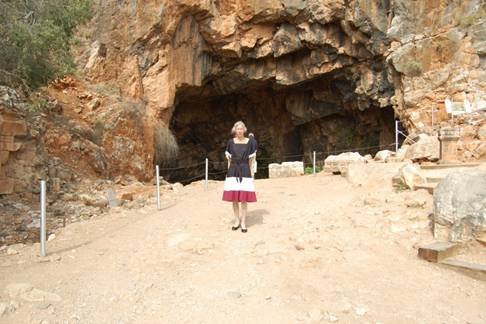
This is a picture of me at the “Gates of Hell” located in the region of Caesarea Philippi in Galilee in 2009 |
|
Spiritual Gates: Biblically speaking, Gates are places of Spiritual Authority, and in the context of Genesis they are “the gates of our enemies:” Again, as written in Genesis 22:17, the Lord told Abraham that his offspring would possess the gates of their enemies. And, when Jesus walked up to the “Gates of Hell” (Matthew 16) in the Galilee and declared into the Spiritual Realm that the Gates of Hell would not prevail against His Church that had its beginnings in the Galilee – He possessed the gates of His enemies just as the Lord told Abraham
Gates are places of Spiritual Authority and when Christ went into the region of Caesarea Philippi where the “Gates of Hell” are located – Christ possessed the gates of His enemies just as the Lord told Abraham his offspring would.
Matthew 16:13-21 13 When Jesus came into the region of Caesarea Philippi, He asked His disciples, saying, "Who do men say that I, the Son of Man, am?" 14 So they said, "Some say John the Baptist, some Elijah, and others Jeremiah or one of the prophets." 15 He said to them, "But who do you say that I am?" 16 Simon Peter answered and said, "You are the Christ, the Son of the living God." 17 Jesus answered and said to him, "Blessed are you, Simon Bar-Jonah, for flesh and blood has not revealed this to you, but My Father who is in heaven. 18 And I also say to you that you are Peter, and on this rock I will build My church, and the gates of Hades shall not prevail against it. 19 And I will give you the keys of the kingdom of heaven, and whatever you bind on earth will be bound in heaven, and whatever you loose on earth will be loosed in heaven." 20 Then He commanded His disciples that they should tell no one that He was Jesus the Christ. 21 From that time Jesus began to show to His disciples that He must go to Jerusalem, and suffer many things from the elders and chief priests and scribes, and be killed, and be raised the third day. NKJV
Verse 21 speaks of “Christ’s Journey from the Galilee to the Cross”:
And, that brings me to Christ’s Journey from the Cross, when Jesus went from the Cross back to the Galilee. The meeting in Galilee was according to God’s will, and of the utmost importance.
From the Cross to Galilee
Even before His Crucifixion Christ told His Disciples that He would meet them in the Galilee after His Resurrection.
Matthew 26:31-32 31 On the way, Jesus told them, “Tonight all of you will desert Me. For the Scriptures say, ‘God will strike the Shepherd, and the sheep of the flock will be scattered.’ 32 But after I have been raised from the dead, I will go ahead of you to Galilee and meet you there.” NLT
Mark 16:5-7 5 When they entered the tomb, they saw a young man clothed in a white robe sitting on the right side. The women were shocked, 6 but the angel said, “Don’t be alarmed. You are looking for Jesus of Nazareth, who was crucified. He isn’t here! He is risen from the dead! Look, this is where they laid his body. 7 Now go and tell His disciples, including Peter, that Jesus is going ahead of you to Galilee. You will see Him there, just as He told you before He died.” NLT
Even before His death and resurrection our Lord and Savior, Jesus of Galilee, told His eleven Disciples, all men from Galilee, that after His death and resurrection to wait for Him in Galilee – He would meet them there (Matthew 26:31-32 and Mark 14:27-28). And, when Mary Magdalene and the other Mary went to visit the Tomb they were met by Christ who told them not to be afraid, to go and tell His Brethren, His Disciples, to leave for Galilee and they would see Him there (Matthew 28:8-10).
Again, why meet them in the Galilee?
Why was it important for Jesus to meet with His Disciples in Galilee?
It was in Galilee where the fullness of Christ’s resurrection would be revealed – where His Disciples would experience the fullness of their Savior who declared “I AM the Light of the World.”
For example, we know it was in the Galilee that Jesus gave the Disciples the “Great Commission.”
And, it was in Galilee that Christ reinstated Peter. In Mark 16:7 we find that the angel who told the women at the tomb to go and tell His disciples that Jesus was going ahead of them to Galilee and the angel specifically mentions Peter by name.
Just before Christ’s death, Peter denied Christ and then after denying Christ, Peter wept bitterly. By making mention of Peter by name, Christ wanted to reassure Peter that He had forgiven him and still loved him. That He had risen and was His Lord and Redeemer, just as He was to the other Disciples.
In Matthew 4:12-17 the Apostle Matthew echoes Isaiah’s Prophecy that the identity and mission of Christ were always linked with the geographical area of Galilee and the Galilee of the Gentiles. More to the point, one would have to ask, why wouldn’t Christ go back to the Galilee after His death and Resurrection? The Galilee is as much a part of Christ’s life, death and Resurrection as His Crucifixion in Jerusalem.
The resurrection narrative in the gospels does not end with the risen Christ’s encounter with the apostles in Jerusalem where He appeared to them on two different occasions. Quite the contrary, the third time Jesus appeared to His Disciples was at the Sea of Galilee (John 21:14). Before and after the crucifixion the apostles were commanded to go to the Galilee where the fullness of Christ’s resurrection would be revealed – where His Disciples would experience the fullness of their Savior who declared “I AM the Light of the World.”
And, meeting Christ in the Galilee after His resurrection was in fulfillment of Isaiah 9:1-2 who prophesied that those living in Galilee would be the first to see the Glorious Light of the Messiah!
In Mark 14:27-28 we find that Christ forewarned the Disciples that they would all desert Him, but after He was raised from the dead, Christ told them that He would go ahead of them to Galilee and meet them there. When Christ met them at the Sea of Galilee, surely the Disciples would have understood the spiritual depth of Isaiah’s prophecy that those in the regions of the Galilee would see a “Great Light.”
Mark 14:27-28 27 On the way, Jesus told them, “All of you will desert Me. For the Scriptures say, ‘God will strike the Shepherd, and the sheep will be scattered.’ 28 But after I am raised from the dead, I will go ahead of you to Galilee and meet you there.” NLT
“Then go quickly and tell His disciples that He has risen from the dead, and behold, He is going before you to Galilee” (Matthew 28:7). “Then Jesus said to them, ‘Do not be afraid; go and tell My disciples to go to Galilee, and there they will see Me’ ” (Matthew 28:10).
The Identity and Mission of the Church are Forever Linked to the Geographical Regions of Galilee and the Galilee of the Gentiles
Galilee is the Birthplace of the Church: It was here at the Galilee that Christ chose eleven Galilean men to be His Disciples. It was in the Galilee where He lived, where He taught, performed miracles and revealed Himself to the Samaritan woman that He was the Messiah.
Nothing in the life of Christ was happenstance. Like everything in the Bible, even the geographical area of Galilee was according to God’s will – hence the “spiritual aspects” of the Galilee and the “Galilee of the Gentiles” are spiritually profound.
On Earth as in Heaven: We know from Isaiah 9:1-2 and Mark 4:12-17 that the spiritual significance attributed to the geographical area of the Galilean borderland is rooted in the history, geography, culture and politics of the region. And, that holds true even today.
The Galilee was located far from the center of Judaism in Jerusalem of Judea and shared a border with a gentile nation (Syro-Phoenicia, modern-day Lebanon). Between sharing a border with present-day Lebanon and living alongside the gentiles that the King of Assyria transported to the Galilee after invading northern Israel, the Galilee was a region of mixed peoples, languages and religions – hence the centuries-old name the prophet Isaiah gave to the area: “Galilee of the Gentiles.”
However, according to the Prophet Isaiah, there was hope for the Galilee and those who were living in the shadow of death: The Crucified and Risen Christ was a Galilean. It was His “Great Light” that the prophet Isaiah spoke of. It was His light that dispelled the darkness in the land of Galilee. It was this Light that the Disciples saw when they met the Resurrected Christ in the Galilee.
The Borderland
We know from John 7:52 and other Scriptures that the Jewish establishment in Jerusalem, the Pharisees and Sadducees, were so self-righteous they could not believe that God would reveal Himself to the unclean and unlearned people of the borderland, be they Jew or Gentile. After all, they considered that Jerusalem was the center of the political, religious, and economic power. However, Jesus was a Galilean and therefore, in their minds, unable to even be considered as God’s Son – the long awaited Messiah.
John 7:52 52 They replied, “Are you from Galilee, too? Search the Scriptures and see for yourself—no prophet ever comes from Galilee!” NLT
What? Surely, the religious Pharisees who were known for their self-righteousness and pride were aware of Isaiah’s Prophecy concerning the Galilee – that it would be those living in the Borderland of the Galilee – the Galilee of the Gentiles that would be the first to see the great and glorious light of the Messiah. Surely, the Pharisees and the religious leaders in Jerusalem knew that the Prophet Elijah was from Tishbe of Gilead in the northern kingdom and that Jonah was from Gath-Hepher, a town in Lower Galilee about five miles from Nazareth. The Pharisee’s religion was a form of religion and nothing more – they were blinded by their own self-righteousness. John the Baptist called them a “Generation of Vipers” (Matthew 3:7) – snakes that felt they were safe simply because they were descendants of Abraham.
What? Surely, the Pharisees and the religious leaders in Jerusalem knew that the Prophet Elijah was from Tishbe of Gilead in the northern kingdom and that Jonah was from Gath-Hepher, a town in Lower Galilee about five miles from Nazareth.
Both geography and doctrine separated Galilee from the religious establishment in Jerusalem. Like all of the religious establishment in Jerusalem, the Pharisees failed to recognize that Jesus was the long-awaited Messiah simply because He was from Galilee.
Yet, not only did Christ spend the first thirty years of His life in the Galilee – Scripture reveals that after His death and resurrection, Christ the Galilean returned to the Borderlands of the Galilee where He told His Disciples they would see Him.
Again, we know from Isaiah 9:1-2 and Matthew 4:12-17 that the geographical aspects of Christ’s life and ministry were according to God’s will.
Which begs the question, “What is the significance of the Borderlands of the Galilee, the region of Zebulun and Naphtali where Jesus withdrew into – land that was part of the Promised land but occupied by Gentiles – and for that reason that region of the Promised land was known as “Galilee of the Gentiles?” The Galilee and the Galilee of the Gentiles was a Borderland where Jews lived alongside the Gentiles; a reviled land, a land of darkness where the people lived in the shadow of death.
Again, the Prophet Isaiah prophesied that in due time a great light would shine on those living in darkness. And Matthew tells us that this light has arisen with the coming of Jesus. And, this light would dawn, not in Jerusalem in the Temple, but in the Borderlands of the Galilee of the Gentiles.
The Samaritans and Gentiles who lived in the Borderlands of the Galilee knew that the Jews, especially the Jews from Judea, believed there were a spiritual boundary as well as a physical boundary between those who were the biological offspring of Abraham, Isaac and Jacob and those gentiles – foreigners who were excluded from citizenship in Israel.
However, because of the Cross, that changed. The Glorious Light of the Messiah was seen by the foreigners living alongside the Jews in the Borderlands of the Galilee where Christ united Jews and Gentiles into one people when He died on the Cross and broke down the wall of hostility that separated us.
Ephesians 2:12-14 12 remember that at that time you were separated from Christ [excluded from any relationship with Him], alienated from the commonwealth of Israel, and strangers to the covenants of promise [with no share in the sacred Messianic promise and without knowledge of God’s agreements], having no hope [in His promise] and [living] in the world without God. 13 But now [at this very moment] in Christ Jesus you who once were [so very] far away [from God] have been brought near by the blood of Christ. 14 For He Himself is our peace and our bond of unity. He who made both groups—[Jews and Gentiles]—into one body and broke down the barrier, the dividing wall [of spiritual antagonism between us], Amplified Bible
The “Great Commission”: Why wouldn’t Christ want His disciples to meet Him in the Galilee, a land where there were as many gentiles as there were Israelites? It was here in the Galilee where He gave them all authority in heaven and on earth. They received the commission that they were to go outside the Borders of Israel and make disciples of all the nations – not just Israel – baptizing them in the name of the Father and the Son and the Holy Spirit.
The Transformation of the Borderland
Jesus’ Encounters in the Borderlands Brought about a “Spiritual Transformation”
Because of Christ the Galilean, the “Spiritual Borders” in the Borderland of the “Galilee of the Gentiles” were Brought Down.
Jesus challenged every Geographical, Ethnic, Gender, Cultural, Religious and Political Boundary That Opposed God’s Redemptive Purposes that Included the Gentiles
In the Borderlands of the Galilee of the Gentiles, the Leper from Samaria who Christ healed, the Samaritan Woman Jesus met at the well, the Roman Centurion, and the woman from Tyre and Sidon whose daughter Jesus healed, were all “unclean,” yet because of their encounter with Christ, they were all made clean. Each of them saw the “Great and Glorious Light” that the Prophet Isaiah spoke of: Christ who said “I AM the Light of the World.”
1. The Unclean Leaper who Jesus healed was a Samaritan who had been made clean because of Christ:
Luke 17:11-19 11 As Jesus continued on toward Jerusalem, he reached the border between Galilee and Samaria. 12 As he entered a village there, ten lepers stood at a distance, 13 crying out, “Jesus, Master, have mercy on us!” 14 He looked at them and said, “Go show yourselves to the priests.” And as they went, they were cleansed of their leprosy. 15 One of them, when he saw that he was healed, came back to Jesus, shouting, “Praise God!” 16 He fell to the ground at Jesus’ feet, thanking him for what he had done. This man was a Samaritan. 17 Jesus asked, “Didn’t I heal ten men? Where are the other nine? 18 Has no one returned to give glory to God except this foreigner?” 19 And Jesus said to the man, “Stand up and go. Your faith has healed you.” NLT
Note: This foreigner would have been from the offspring of the Gentiles that the King of Assyria had sent to Samaria to replace the Jews who he had taken captive to Assyria 2 Kings 17. It was this “foreigner” that returned to thank Christ. Only the “foreigner” who was living within the Borders of Israel who the Jews thought were unclean and lacked knowledge regarding the Laws of Moses was grateful enough to return and give Christ the glory. The foreigner’s faith in Christ healed him. A Samaritan gives thanks, and the Jews who professed religion did not.
2. The Woman Preacher from Samaritan: Jesus brought down the spiritual wall between the Samaritans and the Jews when the first person He told that He was the Messiah was the Samaritan Woman He met at the well. The Jews despised the Samaritans who were half-Jew and half-Gentile. Yet, the first person Christ told that He was the Messiah was a Samaritan who, like the Israelites. was waiting for the Messiah to come. And, she went back to her village “preaching,” bidding the men in her village, “Come and see the Messiah for yourself.”
3. The Roman Centurion: Jesus said He had not seen faith like that of the Roman Centurion in all of Israel. What? The Roman Centurion was a gentile whose government was oppressing all of Israel!
Matthew 8:5-13 5 When Jesus returned to Capernaum, a Roman officer came and pleaded with Him, 6 “Lord, my young servant lies in bed, paralyzed and in terrible pain.” 7 Jesus said, “I will come and heal him.” 8 But the officer said, “Lord, I am not worthy to have you come into my home. Just say the word from where you are, and my servant will be healed. 9 I know this because I am under the authority of my superior officers, and I have authority over my soldiers. I only need to say, ‘Go,’ and they go, or ‘Come,’ and they come. And if I say to my slaves, ‘Do this,’ they do it.” 10 When Jesus heard this, He was amazed. Turning to those who were following him, He said, “I tell you the truth, I haven’t seen faith like this in all Israel! 11 And I tell you this, that many Gentiles will come from all over the world—from east and west—and sit down with Abraham, Isaac, and Jacob at the feast in the Kingdom of Heaven. 12 But many Israelites—those for whom the Kingdom was prepared—will be thrown into outer darkness, where there will be weeping and gnashing of teeth.” 13 Then Jesus said to the Roman officer, “Go back home. Because you believed, it has happened.” And the young servant was healed that same hour. NLT
4. Jesus left the Borderland of the Galilee of the Gentiles and Crossed over the Border into the Borders of Tyre and Sidon: We know from Matthew’s account as recorded in Matthew 15:21-29 that Jesus left the Boundaries of Israel and crossed over into the Borders of Tyre and Sidon where He encountered a Canaanite woman who asked that He help her daughter who was being tormented by a demon.
As a note: In Marks’s account he identifies the Canaanite woman as a Syrophoenician woman Mark 7:24-30.
However, Christ made it clear to the Syrophoenician woman who lived in the regions of Tyre and Sidon located beyond the borders of Israel that His mission was to the Jews – not the Gentiles. Christ went on to compare the Canaanite woman to a dog, and because she was not of the house of Israel, she had no right to claim a blessing from Jesus. Yet, she had the faith to challenge Jesus to defy the spiritual boundaries and show compassion and mercy to her daughter who was tormented by a demon.
And, because of her faith that Christ would show mercy even to those not of the House of Israel – Christ tore down the spiritual boundaries and delivered her daughter from the demonic.
We know from Matthew’s account of Christ’s encounter with the Syrophoenician woman in Tyre and Sidon that Jesus not only brought down the “Geographical Borders” in the Borderlands of the “Galilee of the Gentiles” that physically separated the Jews living in northern Israel from the pagans living in Tyre and Sidon in southern Lebanon – Christ also tore down the spiritual boundaries between Jew and Gentile
Christ brought down the Spiritual Boundaries as well as the Geographical Boundaries that Separated the Syrophoenician Woman from the Jews: She was a Gentile living approximately twelve miles from the Border that separates Israel from Lebanon in the Borderlands of the Galilee of the Gentiles who saw the great and glorious light of Jesus Christ that Isaiah spoke of.
During the encounter with Christ this woman who the Jews considered an enemy of Israel, came to the place that she knew Christ was “her” Lord as much as He was the Lord of the Jews.
Matthew 15:21-29 21 And going away from there, Jesus withdrew to the district of Tyre and Sidon.22And behold, a woman who was a Canaanite from that district came out and, with a [loud, troublesomely urgent] cry, begged, Have mercy on me, O Lord, Son of David! My daughter is miserably and distressingly and cruelly possessed by a demon!
23 But He did not answer her a word. And His disciples came and implored Him, saying, Send her away, for she is crying out after us.
24 He answered, I was sent only to the lost sheep of the house of Israel.
25 But she came and, kneeling, worshiped Him and kept praying, Lord, help me!
26 And He answered, It is not right (proper, becoming, or fair) to take the children’s bread and throw it to the little dogs.
27 She said, Yes, Lord, yet even the little pups (little whelps) eat the crumbs that fall from their [young] masters’ table.
28 Then Jesus answered her, O woman, great is your faith! Be it done for you as you wish. And her daughter was cured from that moment.
29 And Jesus went on from there and passed along the shore of the Sea of Galilee. Then He went up into the hills and kept sitting there. Amplified Bible, Classic Edition
This woman who the Jewish people believed was a total outcast and unworthy of God’s grace, Jesus embraced as a child of God regardless of her nationality or ethnicity. Note that she transitions from addressing Christ as the “son of David” (v 22) to referring to Him as “Lord” (verse 25). In the beginning she addressed Christ using a Messianic title which would have been out of character and unexpected coming from a Gentile who the Israelites considered to be an enemy. However, she was not an enemy of the Gospel of Jesus Christ who she then claimed as her Lord and Savior.
When Christ crossed into the borders of Tyre and Sidon He brought down every geographical, ethnic, racial and culture boundary that was an insult to the Gospel of Christ for according to Galatians 3:28:
Galatians 3:28: “There is neither Jew nor Gentile, neither slave nor free, nor is there male and female, for you are all one in Christ Jesus.” NIV
Jesus claims that Tyre and Sidon were more open to the Gospel than the Galilean cities of Chorazin and Bethsaida Matthew 11:20-21.
The Borderland in Christ’s Lifetime: The ministry of Christ had begun in Galilee and its surrounding areas, including the Borderland of the Galilee of the Gentiles, Israel’s northern border they share with southern Lebanon. It was here that the Church came into being. And, it was here in the Galilee that His ministry found its fulfillment. It was in the Galilee before and after His resurrection that the people saw the “Great and Glorious Light” of our Lord and Savior that dispelled the spiritual darkness that the people had walked in. The Borderlands of the Galilee of the Gentiles, even the land itself was filled with glory. Isaiah 9:1-2
Which begs the question: “Why” was the land filled with darkness and “Why” did the people end up living in darkness and despair – walking in the shadow of death? The Answer: The Assyrian Invasion.
The Darkness of the Assyrian Invasion
To understand how Isaiah’s Prophecy is relevant to present-day events, we need to examine the region of the Galilee starting with Isaiah’s Prophecy as told in Isaiah 9:1-2 going all the way back to when the Galilee was invaded by the Assyrians.
And, when we go back to Isaiah 9:1-2 we will find the answer as to “Why” the Lord held the people in such contempt that the Galilee, the land of Zebulun, the land of Naphtali and the Galilee of the Gentiles, became a land of gloom and darkness. We need to go back to the prophecy in Isaiah 9 and read it alongside Isaiah 8 which gives an account of the Assyrian invasion and the darkness that it brought upon the land. Chapter 8 tells how God used the Assyrians to punish both kingdoms (Israel and Judah) for their sins of idolatry, but, Israel more so than Judah. Chapter 8 ends by describing the gloom and darkness that would cover the northern kingdom of Israel as the devastating force of the Assyrians swept through Israel’s northern kingdom. The last verses of chapter 8 are a more detailed description of the Assyrian invasion given in verses 7 and 8 and the despair and darkness they will be driven into and Isaiah 9:1-2 is a continuation of Isaiah 8.
Isaiah’s prophecy holds the key to understanding why 700 years later that those living in the shadow of death would be the first to witness the Light of Jesus who said, “I AM the Light of the world. Isaiah’s prophecy beginning in chapter 9 reveals that this gloom brought about by the Assyrian invasion would not last forever. That there was the promise of God that in the future He would send a great and glorious light that would dispel the darkness and the land He once held in contempt would be filled with His glory.
Isaiah 9:1-2, written 700 years before the birth of Christ, holds the key to understanding why Christ would live in these very lands once held in contempt for the first thirty years of His life and why Christ told the Disciples to go to the Galilee after His resurrection – that they would see Him there.
By Way of Biblical History:
The Northern Kingdom came to an End When God allowed the Assyrians to Invade the Northern Kingdom and take them into Captivity
Isaiah’s prophecy reveals that the time of darkness and despair would not go on forever for those living in the land of Zebulun and Naphtali. For those once held in contempt by the Lord, the time was coming when their lands would be filled with glory.
Which begs the question: “Why” did God hold the lands in northern Israel in such contempt that the Northern Kingdom came to an end, and how did the land and people end up living in darkness and despair – walking in the shadow of death? It was because of their obstinate perseverance in the sin of idolatry. They were walking in the darkness of their own sins.
We begin with Isaiah’s Prophecy and the Assyrian Invasion of the Ten Tribes of Northern Israel: In Isaiah 9:1-2 those walking in darkness is a reference to the Assyrian invasion of the Ten Tribes of Northern Israel located in the Galilee who were conquered by the Assyrians and carried off as exiles to live in Assyria. To add insult to injury, the Assyrians took pagans from Babylon and other nations they had conquered and sent them to live in the regions of the Galilee to replace the Israelites. When they relocated to northern Israel these foreigners brought the worship of their pagan gods as well as their pagan customs with them further polluting the regions of the Galilee with their idolatry – hence, the Galilee of the Gentiles.
God allowed the Assyrians to invade and Conquer the Ten Tribes of the Northern Kingdom because of their Idolatry: God had allowed the Israelites in the regions of the Galilee to be afflicted by the Assyrians to the point the Northern Kingdom of Israel ceased to exist as a Kingdom because of their idolatry.
2 Kings 15:27-29 27 Pekah son of Remaliah began to rule over Israel in the fifty-second year of King Uzziah’s reign in Judah. He reigned in Samaria twenty years. 28 But Pekah did what was evil in the LORD’s sight. He refused to turn from the sins that Jeroboam son of Nebat had led Israel to commit. 29 During Pekah’s reign, King Tiglath-pileser of Assyria attacked Israel again, and he captured the towns of Ijon, Abel-beth-maacah, Janoah, Kedesh, and Hazor. He also conquered the regions of Gilead, Galilee, and all of Naphtali, and he took the people to Assyria as captives. NLT
2 Kings 17:5-8 5 Then the king of Assyria invaded the entire land, and for three years he besieged the city of Samaria. 6 Finally, in the ninth year of King Hoshea’s reign, Samaria fell, and the people of Israel were exiled to Assyria. They were settled in colonies in Halah, along the banks of the Habor River in Gozan, and in the cities of the Medes. 7 This disaster came upon the people of Israel because they worshiped other gods. They sinned against the LORD their God, who had brought them safely out of Egypt and had rescued them from the power of Pharaoh, the king of Egypt. 8 They had followed the practices of the pagan nations the LORD had driven from the land ahead of them, as well as the practices the kings of Israel had introduced. NLT
The King of Assyria Transported Gentiles to Galilee – hence the Galilee of the Gentiles: After deporting the Israelites from northern Israel to Assyria and making them servants of the Assyrian Empire – the King of Assyria transported people from Babylon and other pagan nations they had conquered and resettled them in the town of Samaria to replace the people of Israel. And, these pagans who the King of Assyria brought to Samaria, the Capital of northern Israel, to replace the Israelites brought the worship of their pagan gods with them to the regions of Galilee.
According to 2 Kings 17:26, the people the King of Assyria sent to live in the town of Samaria sent a message to the King of Assyria that they were being attacked by lions because they were not worshipping the God of Israel correctly. In response, the King of Assyria sent one of the exiled Priests back to Samaria to teach the pagans how to worship the God of Israel. And, even though the pagans began to worship God, they continued to follow their own pagan gods according to the religious customs of the nations from which they came. They simply combined the worship of the God of Israel alongside their pagan gods.
And, this is only one of the reasons the area became known as the “Galilee of the Gentiles.”
The Remnant left behind in northern Israel: According to 2 Chronicles 30:10-11 the King of Assyria left a remnant of the Israelites behind in Zebulun, one of the nations the Prophet Isaiah spoke of in his Prophecy (Isaiah 9:1-2). And, now King Hezekiah is encouraging this remnant who had escaped out of the hand of the Assyrians to not be like their fathers – but to turn back to God.
The Assyrians did not carry away every Israelite to the last man.
2 Chronicles 30:10-11 10 The runners went from town to town throughout Ephraim and Manasseh and as far as the territory of Zebulun. But most of the people just laughed at the runners and made fun of them. 11 However, some people from Asher, Manasseh, and Zebulun humbled themselves and went to Jerusalem. NLT
2 Chronicles 30:17-20 17 Since many of the people had not purified themselves, the Levites had to slaughter their Passover lamb for them, to set them apart for the LORD. 18 Most of those who came from Ephraim, Manasseh, Issachar, and Zebulun had not purified themselves. But King Hezekiah prayed for them, and they were allowed to eat the Passover meal anyway, even though this was contrary to the requirements of the Law. For Hezekiah said, “May the LORD, who is good, pardon those 19 who decide to follow the LORD, the God of their ancestors, even though they are not properly cleansed for the ceremony.” 20 And the LORD listened to Hezekiah’s prayer and healed the people. NLT
Those who had not cleansed themselves are referring to those who came from the areas that had been wholly devoted to idolatry which was the reason why God allowed the Assyrians to invade, conquer and take captive people from the Northern Kingdom of Israel to Assyria.
However, we know from verse 11 that the men from the tribe of Zebulun along with men from the other Ten Tribes of Israel did humble themselves and go up to Jerusalem to celebrate the Passover with their brothers from the Southern Kingdom of Israel. “Humbled themselves” meant that they repented of their idolatry and returned to the Lord.
Going back to Isaiah’s Prophecy:
Galilee Lay Close to the Heart of Jesus’ Ministry: According to the Prophet Isaiah the people living in the land of Zebulun, the land of Naphtali and the Galilee of the Gentiles who had been so afflicted and were walking in darkness would be the first to see the “Great Light of the Messiah” because of the shame and humiliation they suffered at the hands of the Assyrians.
Those Israelites from the Northern Kingdom of Israel were the ones who suffered the most under the oppression of the Assyrians, but because of God’s Mercy, who had allowed the Assyrians to invade and rule over them because of their idolatry, they would be the first to see the great and glorious light of Jesus Christ who lived and ministered in the land of Zebulon and the land of Naphtali and the Galilee of the Gentiles.
We know from Isaiah 9:1-2 and Matthew 4 that the Galilee was at the heart of Jesus’ Ministry. Hence – the Good News of the Gospel of Jesus Christ was first proclaimed by our Lord in Galilee. And, who can forget that the first person Christ told that He was the long awaited Messiah was the woman from Samaria that He met at the well.
The Future of the Ten Tribes of the Northern Kingdom have yet to come to pass: We know from Revelation 7:1-8 that the four angels who had been given power to harm the land and sea could not harm the land or sea until the Seal of God had been placed on the foreheads of His servants, with the exception of the Tribe of Dan, from all the other Tribes of Israel which included the tribes from the land of Naphtali and the land of Zebulun.
Revelation 7:4-8 4 And I heard how many were marked with the seal of God—144,000 were sealed from all the tribes of Israel: 5 from Judah — 12,000 from Reuben — 12,000 from Gad — 12,000 6 from Asher — 12,000 from Naphtali — 12,000 from Manasseh — 12,000 7 from Simeon — 12,000 from Levi — 12,000 from Issachar — 12,000 8 from Zebulun — 12,000 from Joseph — 12,000 from Benjamin — 12,000
That the ten tribes of northern Israel are included in the 144,000 that were sealed is important to note because there are many who claim that the Ten Tribes of northern Israel are “Lost” and that’s simply not true. Of all the tribes listed only Judah and Benjamin are from the Southern Kingdom. The other tribes are all from the Northern Kingdom. I highlighted Naphtali and Zebulun because Isaiah made mention of them in his prophecy of Isaiah 9:1-2. The 144,000 represent the Jews who will embrace Christ as the Messiah.
And, it’s important to once again reference 2 Chronicles 30 that reveals there were native Israelites that the Assyrians left in northern Israel. More to the point, the 144,000 is speaking of the Jewish people from the lands of Israel – not those that are the offspring of the Israelites that went into exile as some Believers living in other countries believe they are among the 144,000 even though they are not Jewish.
Jeremiah 31 is another prophecy that speaks of the future Restoration of Israel’s Northern Kingdom as well as the Southern Kingdom.
The two Kingdoms had two separate histories; for example, the Ten Tribes of Northern Israel were scattered in captivity by the Assyrians and the Assyrians never allowed them to return to the Galilee. On the other hand, God never allowed Assyria to take captives from Judah; however, those from the Southern Kingdom of Israel were forced into captivity at the hands of Babylon, but decades later were allowed to return to southern Israel and rebuild. Anyone who knows the Biblical history of Israel knows that at the time, the Southern Kingdom and Northern Kingdom were not a united kingdom.
For example, the Samaritans believed that they were to worship God at Mount Gerizim – not in Jerusalem.
John 4:19-26 19 “Sir,” the woman said, “you must be a prophet. 20 So tell me, why is it that you Jews insist that Jerusalem is the only place of worship, while we Samaritans claim it is here at Mount Gerizim, where our ancestors worshiped?” 21 Jesus replied, “Believe me, dear woman, the time is coming when it will no longer matter whether you worship the Father on this mountain or in Jerusalem. 22 You Samaritans know very little about the one you worship, while we Jews know all about him, for salvation comes through the Jews. 23 But the time is coming—indeed it’s here now—when true worshipers will worship the Father in spirit and in truth. The Father is looking for those who will worship him that way. 24 For God is Spirit, so those who worship him must worship in spirit and in truth.” 25 The woman said, “I know the Messiah is coming—the one who is called Christ. When he comes, he will explain everything to us.” 26 Then Jesus told her, “I AM the Messiah!” NLT
And, by all accounts there are differences between southern and northern Israel to this day.
However, we know from Jeremiah 31:4-6, 10-12 as well as John 4:19-26 that the time is coming when all twelve tribes of Israel will unite. Jeremiah 31:4-6
The Future Restoration of the Ten Tribes of Israel according to the Prophet Jeremiah: Verses 4-7 of Jeremiah 31 says it all!
Jeremiah 31:4-9 4 Again I will build you, and you shall be rebuilt, O virgin of Israel! You shall again be adorned with your tambourines, And shall go forth in the dances of those who rejoice. 5 You shall yet plant vines on the mountains of Samaria; The planters shall plant and eat them as ordinary food. 6 For there shall be a day When the watchmen will cry on Mount Ephraim, 'Arise, and let us go up to Zion, To the LORD our God.' " 7 For thus says the LORD: "Sing with gladness for Jacob, And shout among the chief of the nations; Proclaim, give praise, and say, 'O LORD, save Your people, The remnant of Israel!' 8Behold, I will bring them from the north country, And gather them from the ends of the earth, Among them the blind and the lame, The woman with child And the one who labors with child, together; A great throng shall return there. 9They shall come with weeping, And with supplications I will lead them. I will cause them to walk by the rivers of waters, In a straight way in which they shall not stumble; For I am a Father to Israel, And Ephraim is My firstborn. NKJV
Note that in verses 5, 6 and 9 Jeremiah specifically mentions the future restoration of Samaria, the Capitol of the Northern Kingdom and the Northern Tribe of Ephraim – that God is Israel’s father and that Ephraim is His oldest child verses 8-9. In verse 7-8 Jeremiah prophesied that the Lord would bring the remnant of Israel back from the north and from the distant corners of the earth – that a great company would return.
References to Samaria (verse 5) and the Tribe of Ephraim (verses 6 & 9) speak of the survivors and their descendants from the northern tribes that were exiled by Assyria. The prophet Jeremiah reveals that the Northern Tribes would return to their lands – Jeremiah specifically mentions the northern Tribe of Ephraim. Verses 18-21 speaks of the exiles returning to the northern Tribe of Ephraim. Restoration of the northern tribes who were exiled, not of those the Assyrians left as a remnant in the land is at the heart of verses 2 to 22.
Those that went into exile to the north, they will now return home from the north. The people will return home because the Lord would bring them home. Their deliverance from the lands of the enemy they had been taken captive to was according to the will of God, so God would surely bring it about.
Jeremiah 31 reveals the Mercy of God and His faithfulness to His covenant with Abraham: God promises that the time is coming when the northern tribes of the Galilee will return and that under the New Covenant, they and the Southern Kingdom will all come to know God's Mercy and complete forgiveness.
The Kings of Assyria were not the only Gentiles that left their mark on the Galilee: Hiram, King of Tyre and Sidon played a major role in the “Galilee of the Gentiles. It’s unthinkable that King Solomon gave twenty towns in Galilee to Hiram, King of Tyre and Sidon (Lebanon) because Hiram had supplied Solomon with all the cedar and gold Solomon needed in the building of the Temple. These twenty towns would have been located at the border between Israel and Lebanon in what is now known as the “Galilee of the Gentiles.” 1 Kings 9:11-14
1 Kings 9:10-11 10 It
took Solomon twenty years to build the LORD’s Temple and his own royal
palace. At the end of that time, 11 he gave twenty towns in the
land of Galilee to King Hiram of Tyre. (Hiram had previously provided all the
cedar and cypress timber and gold that Solomon had requested.) NLT The twenty towns King Solomon gave to Hiram, King of Tyre and Sidon were in the “Galilee of the Gentiles,” which was located at the border between northern Israel and southern Lebanon. The “Galilee of the Gentiles” is a reference to the land occupied by the pagans that the King of Assyria had sent to the area to replace the Jews he took to Assyria. This area was also referred to as the “Galilee of the Gentiles” because they shared a border with pagan nations like that of Tyre and Sidon. As a note, many people today refer to the “Galilee of the Gentiles” as “Upper Galilee;” however, the Biblical name for Upper Galilee is the “Galilee of the Gentiles.”
And, Christ left His mark on Tyre and Sidon: Christ Himself crossed over from Israel into the borders of Tyre and Sidon cities north of the Galilee of the Gentiles.
Mark 7:24 24 And from thence he arose, and went into the borders of Tyre and Sidon, and entered into an house, and would have no man know it: but he could not be hid. KJV
Mark 7:24 24 Then Jesus left Galilee and went north to the region of Tyre. He didn’t want anyone to know which house he was staying in, but he couldn’t keep it a secret. NLT
Christ spoke about the character of those living in Tyre and Sidon:
Luke 10:12-14 12 I tell you, it shall be more tolerable in that day for Sodom than for that town. 13Woe to you, Chorazin! Woe to you, Bethsaida! For if the mighty miracles performed in you had been performed in Tyre and Sidon, they would have repented long ago, sitting in sackcloth and ashes. 14However, it shall be more tolerable in the judgment for Tyre and Sidon than for you. Amplified Bible, Classic Edition
Even though Christ had been sent to the Jews, He still ministered to the needs of those from Tyre and Sidon. We know from Mark 3:7-8 that people from Tyre and Sidon who had heard about His miracles came to see Him. And, who can forget the Syrophoenician woman whose daughter Christ set free – Matthew 15:21-28. Christ even commended her for her “Great Faith.”
Even though Christ was sent to the lost sheep of Israel, they rejected Him. Yet, those from Tyre and Sidon showed Christ more kindness and more readily repented.
The following are other examples of the relationship between the Jews from the northern Kingdom and Tyre and Sidon as well as King Solomon’s relationship with Tyre and Sidon. These are all Scriptures that help us to understand why the Upper Galilee is referred to the “Galilee of the Gentiles.”
We know from Judges 1:30-33 that the Tribe of Zebulun and the Tribes of Naphtali failed to drive out the Gentiles; instead, they moved in among the pagans who controlled the land. To make matters worse the Israelites began to worship the pagan gods, including the “gods of Zidon (Sidon)” Judges 10:6.
Judges 1:30-33 30 The tribe of Zebulun failed to drive out the residents of Kitron and Nahalol, so the Canaanites continued to live among them. But the Canaanites were forced to work as slaves for the people of Zebulun. 31 The tribe of Asher failed to drive out the residents of Acco, Sidon, Ahlab, Aczib, Helbah, Aphik, and Rehob. 32 Instead, the people of Asher moved in among the Canaanites, who controlled the land, for they failed to drive them out. 33 Likewise, the tribe of Naphtali failed to drive out the residents of Beth-shemesh and Beth-anath. Instead, they moved in among the Canaanites, who controlled the land. Nevertheless, the people of Beth-shemesh and Beth-anath were forced to work as slaves for the people of Naphtali. NLT
Judges 10:6 6 And
the children of Israel did evil again in the sight of the LORD, and served
Baalim, and Ashtaroth, and the gods of Syria, and the gods of Zidon, and the
gods of Moab, and the gods of the children of Ammon, and the gods of the
Philistines, and forsook the LORD, and served not Him. KJV Other facts about the Sidonians:
The Parable of the Good Samaritan: Samaria was the “Capital of the Northern Kingdom”
Luke 10:25-37 25 One day an expert in religious law stood up to test Jesus by asking him this question: “Teacher, what should I do to inherit eternal life?” 26 Jesus replied, “What does the law of Moses say? How do you read it?” 27 The man answered, “‘You must love the LORD your God with all your heart, all your soul, all your strength, and all your mind.’ And, ‘Love your neighbor as yourself.’” 28 “Right!” Jesus told him. “Do this and you will live!” 29 The man wanted to justify his actions, so he asked Jesus, “And who is my neighbor?”
30 Jesus replied with a story: “A Jewish man was traveling on a trip from Jerusalem to Jericho, and he was attacked by bandits. They stripped him of his clothes, beat him up, and left him half dead beside the road. 31 “By chance a priest came along. But when he saw the man lying there, he crossed to the other side of the road and passed him by. 32 A Temple assistant walked over and looked at him lying there, but he also passed by on the other side. 33 “Then a despised Samaritan came along, and when he saw the man, he felt compassion for him. 34 Going over to him, the Samaritan soothed his wounds with olive oil and wine and bandaged them. Then he put the man on his own donkey and took him to an inn, where he took care of him. 35 The next day he handed the innkeeper two silver coins, telling him, ‘Take care of this man. If his bill runs higher than this, I’ll pay you the next time I’m here.’ 36 “Now which of these three would you say was a neighbor to the man who was attacked by bandits?” Jesus asked. 37 The man replied, “The one who showed him mercy.” Then Jesus said, “Yes, now go and do the same.” NLT
One would have expected the Priest to stop and help the injured man from Jerusalem – one of his own brothers. However, the priest crossed to the other side of the road and went on his way. On the other hand, it was a Samaritan man who had compassion on the injured Jewish man from Jerusalem. Given their hatred for all Samaritans, the injured man from Jerusalem had no right to expect help from a Samaritan, yet the man from Samaria was the very one who helped him.
The first person Christ Revealed Himself as the Messiah was to a Samaritan Woman:
John 4:19-26 19 “Sir,” the woman said, “You must be a prophet. 20 So tell me, why is it that you Jews insist that Jerusalem is the only place of worship, while we Samaritans claim it is here at Mount Gerizim, where our ancestors worshiped?” 21 Jesus replied, “Believe Me, dear woman, the time is coming when it will no longer matter whether you worship the Father on this mountain or in Jerusalem. 22 You Samaritans know very little about the one you worship, while we Jews know all about Him, for salvation comes through the Jews. 23 But the time is coming—indeed it’s here now—when true worshipers will worship the Father in spirit and in truth. The Father is looking for those who will worship Him that way. 24 For God is Spirit, so those who worship Him must worship in spirit and in truth.” 25 The woman said, “I know the Messiah is coming—the one who is called Christ. When He comes, He will explain everything to us.” 26 Then Jesus told her, “I AM the Messiah!” NLT
The Apostle John tells us that the First Person Jesus revealed Himself to as the Long Awaited Messiah was a Woman from Samaria, a Town in the Vicinity of Galilee. John 4
And, that brings me to the Account of the Samaritan Woman – the Woman Preacher of Samaria.
The Woman-Preacher of Samaria: The First Person Jesus Revealed Himself to as the Long Awaited Messiah Was a Woman from Samaria, a Town in the Vicinity of Galilee that Isaiah spoke of in Isaiah 9:1-2
Which begs the question, “why” was the first person that Christ revealed that He was the Son of God a Samaritan Woman – who was half Jew and half Gentile and who combined the worship of God with that of the pagans?
The Samaritan woman lived within the very regions of the geographical area that was Prophesied by Isaiah: The Apostle Matthew tells us that Christ’s ministry in the Galilee of the Gentiles is a fulfillment of Isaiah’s prophecy and that His ministry was tied to the geographical area of the Galilee, which explains why Christ spent the first thirty years of His life and Ministry in the Galilee. And, it is through the lens of Isaiah 9:1-2 and Matthew 4:17-22 that we need to keep in mind if we want to understand why the first person that Jesus revealed that He was the Messiah was the Samaritan woman who lived within the very geographical area that was Prophesied by Isaiah. And, it is through the lens of Isaiah 9:1-2 and Matthew 4:17-22 that we can understand why the first person that Jesus revealed that He was the Messiah was the Samaritan woman who lived within the very geographical area that His ministry was tied to.
Christ’s encounter with the Samaritan Woman is nothing short of Profound!
After the King of Assyria conquered northern Israel, he deported the Jewish people living in the Galilee and Samaria (which was the Capital of the Ten Northern Tribes at that time) to Assyria where they lived among the pagans in spiritual darkness. And, the pagans the King of Assyria sent to Samaria to replace the Samaritans brought with them their pagan customs and gods, which allowed a spiritual darkness to spread throughout Samaria. The Gentiles from Assyria became the occupants of the Holy Land in northern Israel intermarrying with the Jews that were left behind, which resulted in a religion that combined Paganism with Judaism. 2 Kings 17
And, only the Great Light of Christ as prophesied by Isaiah could set the “Offspring” of those that had been conquered by the Assyrians who were now living in Samaria free from this spiritual darkness that still covered the land and deliver them from the Shadow of Death they lived under.
The ancestors of the Samaritan woman had long ago died but the “spiritual darkness” still hovered over the land in the Galilee and Galilee of the Gentiles, and it was this darkness that the Samaritan woman and others were walking in; that is, until they saw the great and glorious light of Jesus Christ that set them free.
When the King of Assyria conquered northern Israel he brought with him darkness. And, it was when the Prince of Peace was born and lived the first thirty years of His life in the Galilee and Galilee of the Gentiles that the great light of Christ dispelled the darkness of the Assyrian Empire ushered in by the King of Assyria.
And, it’s profound that the Samaritan Woman was the first to recognize Jesus as “The Light of the World.”
And, that brings me to the following account of “The Woman-Preacher of Samaria” written by George Keith, a personal friend of my Scottish Forebears, over three hundred years ago.
“The Woman-Preacher of Samaria” written by George Keith
At this point I want to include excerpts from a book, “The Woman Preacher of Samaria,” written over 300 years ago by George Keith, a Quaker, who was a personal friend of my Scottish forebears Alexander and Lilias Skene. In fact, Alexander Skene and George Keith were imprisoned for their beliefs and co-authored a Book, "The Way Cast Up, And the Stumbling -blocks removed from before the feet of those, who are seeking the way to Zion, with their faces thitherward,” (Jeremiah 50:5) while in prison.
My forebear, Lilias Skene, was the leading Female Quaker in Aberdeen, Scotland and was a personal friend of George Keith who took her with him on his journeys along with William Penn in their travels to the Netherlands and Germany.
Excerpts as follows: |
|
THE Woman-Preacher OF SAMARIA; A Better Preacher, and more Sufficiently Qualified to Preach than any of the Men-Preachers of the Man-made-Ministry in these Three NATIONS.
By George Keith – Printed in the Year 1674.
THE Woman-Preacher OF SAMARIA.
Come hither all you Men-Preachers, of a Man-made-Ministry, in the three Nations; whether Conformists, or Nonconformists unto the present way of the Ministry, and Worship in these Nations Established by an Humane Law, who cry out against Womens Preaching, and Speaking, and say, Women ought not to Preach, There should not be Women Preachers, They should keep them to the Affairs within the House, and not meddle with our holy Function.
The Woman Preacher of Samaria
Behold, a Woman-Preacher! the Woman of Samaria (John 4.) who may be an Example unto you all; and the best of you, and most Learned and Qualified of you all, have need to learn of her how to Preach.
This Woman of Samaria may be your School-Mistress to teach you to Preach; and it were good for you to learn of her, who though being dead, yet speaketh unto you.
Verily, she is a witness for God, unto the true way of Ministry, and Preaching, against you all, and against all your false and invented ways. Oh for shame let alone your crying out against Women-Preachers; while you are short, exceedingly short of this Woman-Preacher of Samaria: and, first of all, learn the true silence, and to have that mouth in you stopped, which God hath never opened; that the true mouth which is of His opening, you may come to witness, or else for ever to be silent: that Him you may know to open your Mouths, who hath the Key of David, who shutteth, and no man openeth; and openeth, and no man shutteth.
The Woman then left her Water-pot, and went her way into the City, and saith unto the Men,
Then they went out of the City, and came unto him, &c. John 4.28, 29, 30. Here she Preached Christ in few words, but very effectually, and with good success.
Come, See a Man that told me all things that ever I did, is not this the Christ?
These were her words, few and short, but very material, and Pertinent; and very powerful and effectual, as appeared by the good success her words had upon the men of the City: for it is said, Then (to wit, after her speaking to them) they went out of the City, and came unto Him: and v. 39. it is said,
but v. 41. it is said, and many more believed, because of His own Word. But, How came this Woman to be a Preacher of Christ?
First, Who taught her?
Secondly, Who called her?
Verily she was not taught by Men, nor by Men was she called, but by Christ.
She had not been learned at the University, neither got she her Ordination, either by the laying on of hands, of a Bishop, or company of Men, called a Presbytery: yea we find no hands that Christ laid upon her in the outward, but spoke unto her, and talked with her, and she with Him.
So then she was taught of Christ Himself, that He was the Messiah, or the Christ.
She had heard of the Messiah that was to come, but she knew not that He was come, or who He was: yea for some time, though He was speaking unto her, she did not know Him to be the Christ; but when He said unto her, I that speak unto thee am He, then she believed, and went her way into the City, and Preached Him unto the men of the City.
So first of all,
This is an excellent Pattern, and Example unto all true Ministers, and Preachers of Christ▪
And this same Method Paul followed; who, of a Persecutor of Christ, became a Preacher of Him.
When it pleased God, said he, to reveal his Son in me, that I should Preach Him to the Gentiles.
And Secondly, he was a believer in Him, as he said himself, We having received the same Spirit of Faith, we believe, therefore we speak; and, said David, I believe, therefore have I spoken. And what sort of Faith was this?
Historical Faith verses Inward Faith
Was it only an Historical Faith, which Hypocrites, and ungodly Men have, whereof Paul and David spake?
Nay surely, it was the true, saving, renewing, and sanctifying Faith, and according unto this, none ought to preach, who have not a measure of true and saving Faith, and who are not truly in some measure Sanctified and renewed, and by being Sanctified and renewed through Faith by the operation of the Holy Spirit, are fitted and prepared for the work of the Ministry.
Now, by these two qualifications of a true and right Preacher of Christ, let us try the Ministers and Ministry of those called Preachers in these Nations; both Conformists, and Non-Conformists, Both of them affirm, and hold it as their Principle, That true and saving Faith is not necessary unto a Mans being a Preacher: It's true they say, if he be a true Believer, and godly Man, he will be the better Preacher, but a true and Lawful Preacher he is, and ought to be followed, and heard, and maintained, though he be not in the least a godly Man, or true Believer, if he be a Scholar, and can Preach in a Form of Sound words, if he have Latine, Greek, and a little Hebrew and Logick, and such like Natural Arts and Sciences, it is enough to qualify him to be a Preacher; and this Principle James Durham, a great Presbyterian, expresly holds in his Book, called, An Exposition upon the Revelation, in his digression concerning the Ministry, and I myself have had sundry debates, with both Conformists, and Non-Conformists so-called, touching this same thing; both affirming that true Faith and Piety was not needful to a Mans being a Preacher, but that Letter Learning was needful; so that he could not be a Preacher without Letters, but he could be a Preacher without Faith and Piety. Oh abominable Doctrine! And this same Rule both follow, in their trying of mens qualifications unto the Ministry; they try what knowledge they have in strange Languages, and Arts and Sciences Natural, and what they can say upon pages of Scripture, but never one word they question them concerning the work of God in their hearts, or concerning their Faith and Piety.
But alas! how can they try them concerning the work of Grace in their Hearts, seeing they acknowledge they have not a discerning themselves, whereby to know them surely and infallibly; yea, they affirm there is no such discerning in these days, as whereby men can be known to be truly gracious. And doth not sad Experience show it, that the generality of those Preachers have not true Faith and Piety, their Lives and Conversations are so gross and Carnal? Yea, do not many of themselves see it, and have they not complained of it? And yet doth not this Principle of theirs, That wicked Men may be Preachers, and ought to be Received, lay a Foundation for a wicked ___? And ____ being laid with their own Hands, will not wicked Men come in thick and throng? And will not these _______ to have all like themselves? If they can have a wicked Man will not the wicked prefer him to another that but seems to be a godly, and may, or may not be, and thus in process of time the whole Ministry will consist of ungodly men, the wicked being still preferred by the wicked; and carrying it by most Votes, as among them called Presbyterians, or by the Authority of the Bishop, as among the Episcopal. Oh! for shame never say, that you are for a godly Ministry, while you both lay such a Foundation for the ungodly.
And Secondly, as both sorts hold that true Faith and Piety is not necessary to a Mans being a Preacher, so they hold that immediate revelation, and to be immediately taught by Christ Himself, is not necessary, either to his being, or better being, yea, they wholly exclude it, and affirm that all immediate Revelation and Teaching by Christ Himself, so as to teach Men the Truths of the Gospel, is ceased since the Apostles days, and is no more to be expected while the World lasts; so James Durham, concerning Prophesying in his afore said Book, and in the first Page of that Book, he saith, God hath spoke His last words to his Church, by John, in the Revelation; and so the Church nor any in the Church is not to hear any word from God, or Christ Himself; nay, He hath spoken His last words sixteen hundred Years ago. Oh gross blindness and darkness! Is the Lord wholly absent from His Church? Or if He be present with her, and in her, doth He never speak Himself? Hath he lost the power of His Speech, or His willingness to speak, that He hath been so long silent? Surely, nay, as it is written, Our God will speak, and not keep silence, He is not so unkind, nor hard-hearted, as those Men would make Him, so as not to speak Himself.
And as concerning the immediate Teachings of Christ, who is such a Stranger unto them, and their Principles, who know not that they deny them, and are Enemies unto them, and that one of the main things of Controversie betwixt them and us lyeth here; they say, the immediate Teachings of Christ are all ceased, since the Apostles days;
We say, not, and we are Witnesses of the contrary in our Experience, who witness the New Covenant fulfilled, they shall be all taught of the Lord, that is, immediately, else what doth the new excel the old, and first Covenant in? For under the old they were taught of the Lord immediately, as by Moses and the Prophets; but under the new, they are taught of God himself, who dwelleth in them, and walketh in them, and is their Teacher, Shepheard, and Husband.
And now, How can these Men be taught of the Lord himself, or immediately to Preach Christ, who deny the thing itself? How can we have Charity unto them to believe they are so taught, while they deny that any are so taught in those days?
And then what is their Preaching of Him? it is but by hearsay, and report; they are all short of this Woman, She both heard Christ Himself, and saw Himself, which none of them, (as they confess,) have ever done:
they say they have never seen Him, nor heard Him, nor spoken with Him, and yet they preach;
whereas she both heard Him, and saw Him before she Preached Him;
and thus did John, and the Apostles Preach Him: That which was in the beginning, which we have seen with our eyes, and heard with our ears, and our hands have handled of that Word of Life we declare unto you; for the Life was manifested, and we have seen it, and declare it unto you, that you may have fellowship with us, &c.
Now which of the two ways of Preaching are the best;
Surely this was the best, and therefore this Woman is a better Preacher, than all your University men, and Doctors, and Bachelors: she learned more of Christ from Himself, in that small time, (perhaps not one hours length) than your Doctors, and University men have yet learned, for all their many years Studying laboring, Reading, and Hearing: As Christ, upbraided the Jews, that they had neither heard his Fathers Voice, nor seen His shape; so it may be said of them; yea, they say it themselves, they have neither heard Him, nor seen Him. Alas for such Teachers! What should men hear them for? they can tell us no more of Him, but as they have heard it from men, or read it in the Scripture; and all their knowledge is from the Scripture, and all have the Scripture as well as they, and so without them, by the Scripture, may know as much of Christ as they, and save both their pains, and their Money.
And as concerning this Woman, it is manifest, that as she heard Him, and saw Him outwardly, so she both heard Him, and saw Him inwardly, and was taught by His spirit in her heart; for had she not been inwardly taught, and heard inwardly, she could not have believed on Him, which she did: neither had the outward hearing and seeing made her blessed; for many heard and saw Him outwardly, and yet were not blessed: But, said Christ to his Disciples, Blessed are your eyes, for they see, and blessed are your ears, for they hear; this was inwardly, they both heard and saw inwardly, and this made them blessed, whereas others heard and saw outwardly, and therefore were not blessed, as the Disciples, and this Woman was.
Yea that she was taught inwardly, and that more largely, and fully, than by what she heard outwardly it doth manifestly appear from her words, in that she said, He hath told me all things that ever I did: now this could not be outwardly, for he told her but some things outwardly, as concerning her husband's that were dead, and how the man she had, was not her Husband; and certainly, in so small a time as they had together, words outwardly could not have told her the half, yea, not the hundred part of all that ever she did; she was therefore inwardly taught by him, and told all these things.
Christ Jesus the Word, the Life, the Light in her heart told her, as He well could, even in a moment or the twinkling of an eye bring all things before her, and tell her all things in her whole life; and certainly this was it that made her to believe Him, to be not only a Prophet, but more than a Prophet, even the true Messiah, or Christ. He who hath told me all that ever I did, this must be Christ, this cannot but be more than any of the Prophets, who told me some things, but no Prophet could tell me all but Christ only, who is the true God, and knoweth all things, and searched all my inward parts and thoughts.
As concerning her Call, (as was said) she had it not from Men, and indeed we read not of any outward Call she had from Christ; but certainly He who taught her inwardly, called her also inwardly, by his Holy Spirit; yea, so powerful was her inward Call, and the motion of the Spirit of Christ within her, that it caused her to make hast, she tarried not to carry home her water pot, for it is said expressly, she left here water-pot, and went into the City, and said unto the Men, Come, see a Man, &c.
But as for their Call, it is wholly from Men, and by Men; for as they deny all immediate Teaching, so they deny immediate Calling unto the Ministry; yea, their Principle that immediate Revelation is ceased, and that the Scripture is the only Rule, obliged them to deny all immediate Calling, as well as immediate Teaching.
Behold then how she hath this third qualification of a true Preacher which they want; she was called immediately by the Spirit of Christ in her heart; she ran not unsent, it appears the Lord sent her, and was with her by His Spirit, by the good effect her Testimony had; for, as it is said, many of the Samaritans of that City believed on Him, &c.
And this was through her Preaching.
They did not despise her because she was a Woman, they did not say unto her (as many now say) thou art a Woman, thou should not Preach; neither did they say unto her, thou art but Ignorant and unlearned, as Men commonly say now unto our Friends whom God hath taught, by His Holy Spirit, though they have not the Tongues, nor the Natural Arts, and University Learning; Why do ye Preach who are unlearned, and have not been at the University?
I say, these Men, they neither upbraided her with her being a woman, nor secondly, with her being unlearned; nor thirdly, that she wanted her Call, and was idle, or meddled with a business that did not concern her; they did not say unto her, Go home to your wheel, and your Spinning, and such like words, as men commonly now say to Women Friends, whom the Lord hath taught and Called by his Spirit to testify of Him, as He did this Woman of Samaria. Nor fourthly, did they upbraid her with the place, as men commonly also now do, who wonder, and gaze, and mock, and scorn, if they see or hear any speak anything of Christ in the streets; O, say they, this is not the Church, go to Church, if ye would Preach, this is not a fit place to Preach in. These Men of the City did not so unto this Woman, though she came unto them, and spoke unto them, where she first found them, which might be in the streets or anywhere else.
Also, this Woman, no doubt very unexpectedly, and far from any design she had before had unto this work, became a Preacher, little knew she, or little did she think, before she met with Christ, and heard Him, that she should preach Him, nay verily, she knew nothing of it at all, nor had she any such design before hand; far contrary unto these Preachers of the Man-made-Ministry, who have designed it long before hand, and it was a design of their Parents and Relations even from their Childhood: Yea, this was the end, and final moving cause, of their being sent first to the Grammar-School, and then to the University; a design they should be Preachers: Quod est ultimum in Executione, est primum in intentio∣ne: i. e. what is last in Execution is first in intention, so it was first of all intended. A Father hath three Sons, one of them he thinks may be fit to be made a Lawyer, another to be a Doctor of Physics, a third (and that commonly the greatest Dunce or Dolt of the three, finding him not so fit for other things) he resolves he will have him a Minister, or Preacher, that it may be a Living to him; and so away be send them all to the Grammar School, and from that to the University; and thus one becomes a Preacher only by that which is Natural and Artificial, as the other two becomes the Lawyer and Physician, here is nothing of God or Christ seen more in the one than in the other: Is it not so generally among them?
They are become Preachers by a design or contrivance of their Parents, or themselves. As soon as they become but so old,
for if he had been of never so mean a degree, and of the most abject and mean Parents in all the Country, yet to become a Preacher, makes him to be esteemed a Gentleman, and be called Sir; and perhaps, to be advanced to be a Bishop, and then he will be called, my Lord.
But how many either of one sort or another of them, whether Episcopal or Presbyterian, are to be found, who have been called from some other Calling or Occupation they were in before, to leave it, and go to Preach Christ, as this Woman was called from her Water Pot immediately to go Preach him, in a City of Samaria, called Sychar?
And yet thus were the true Servants of the Lord called, who were Mechanick Men, and Tradesmen, both Prophets, and Apostles; Elisha was called from the Plough, Amos from the Heard, who was an Herd-man, and a gather of Sycomore Fruit; and the Apostles, many, or most of them from their Fish-Nets, who were Fishers; Matthew from the Receipt of Custom, who was a Publican, and Luke was a Physician, and Paul a Tent-maker: and so most part of all whom God ever sent to Preach had their Employments before, and not one ever became a Preacher by an Humane design or intention before hand in order unto a Living, and to get money as they do: and so this is a fourth difference betwixt this Woman-Preacher of Samaria and them, wherein she excelled them. Her Preaching was not any Humane design, either of her, or any Man, or men else, but it was wholly Divine, it was of the Lord alone, He designed it, and not Man; whereas their preaching commonly and generally is a
She preached Christ freely, as she had freely received, so she freely gave;
She did not begin to Contract, or Covenant, or bargain with them before hand, for money, or for any Worlds good; she said not unto them, what money or Hire will ye give me, and I will preach Christ unto you?
Nay, nay, she was not of such a Mercenary Spirit, she was more Noble; far unlike the preachers of the Man-made-Ministry in these days, whether Episcopal, or Presbyterian, as well as Popish, where all is done for money, no money, no preaching, as the old proverb is, No penny, No Pater Noster; And was it not so generally among the Presbyterians, while they had the public places, and the Law of the Nation to stand by them, and for them, who of them all preached without a stipend?
Which is in plain English, Wages or Hire; for stipend being a Latin word, signified properly Wages or Hire, but they will not have it called Wages or Hire, lest they should seem to be Hirelings; they will take the Hire, they will seek it, yea, exact it, yea, strain and distrain, and poind, and cast into prison for it, and take away a poor man's pot or pan, or platter for it, as was done to some of our Friends in the Presbyterian time, and this to pay those men's stipend, who were called Godly men of the finest sort of the Presbyterians: A strange thing of exacting wages of them, and forcing them to give them money, who never hired them, nor heard them, and so took none of their Merchandise, and yet thus it was, as they are living at this day, who can witness it done thus unto them, so (as is said) they would take the Hire, and force it, but they will not have it called Hire, but stipend; they must put a Latin face upon it, that it may not appear in it's own deformed and ugly shape, it must be called stipend, and not Hire, whereas the proper English of stipend, is Hire; And now that they are out of their public places, having gone out through fear, if any of them preach now and then in private places, without a set stipend, that is but in order to propagate, and carry on the Presbyterian design, that they may be set up again, and recover their places, and Hires again. But which of them can say in the sight of God, at this day, they preach freely without an eye to money or outward reward? So that if they got nothing by it yet preach they must: Who of them all can say, Woe unto us if we Preach not the Gospel, for a necessity is laid upon us to Preach; Who of them have got their mouth opened by Him to Preach, who opened and no man shut, and shut and no man opened? Has not Man, and the power and dread of Man, oft shut their mouths, and Man, with a little of his forbearance, or winking at them, opened them again? how much of this has been seen these years by past among these called, or accounted the best sort of them? where were they to be found in times of hazard, when the power and dread of man threatend them to suffer imprisonment, or Fining, or the like; so that it was likely they would be apprehended, and haled to prison, to lay there they knew not how long, or have a Fine taken of them.
Did they preach then openly and in view? Could their voice be heard in the streets? No surely. But if an Indulgence come, or that the Magistrates wink a little at them, and they observe it, then they will come out of their holes, and creep forth a little into common view or observation. And thus man shut them, and man open them; for they know not Him nor his opening, who opened and no man shut, and shut and no man opened.
And doth not all this exceedingly betray and discover them to be of a Covetous, and Mercenary Spirit, Hirelings indeed, who flee from the sheep in a time of hazard, whereas the good Shepherd lay down His life for the sheep.
Surely this Woman of Samaria was of a more noble Spirit, who Preached both freely, and boldly.
Though she was a Woman, yet she was not afraid to bear Testimony of Christ, she did not call them, to whom she preached into a Cellar, or Vault under the ground, or some private place, but openly, and publicly she preached Him to a great company, so many heard and believed because of her saying, and yet no doubt there was a hazard so publicly to confess Him, and own Him in that day; and though some believed in Him, yet others were enemies to Him, who were Samaritans.
The Manner how she preached Christ, is observable,
Also it is observable, the pithy and effectual way of hear reasoning, by Question, or Interrogation, which implies both a strong affirmation, and a clear inference or induction from the premises, leaving it as it were unto themselves to judge, or conclude, Is not this the Christ, who has told me all that ever I did? this cannot be a meer man, this cannot be only a Prophet, this must be the Christ, seeing He hath told me all that ever I did.
How effectually doth she reason, as she was taught by the Spirit of Christ in her, though she never learned the Art of Logic, yet surely she reasoned most effectually, and saw more into the reason of the thing, than all the University men have done unto this day, by all their artificial Logic.
And her Reason, or Argument runs thus. He who tells a man or woman all that ever they have done, must be Christ: but this man has told all that ever I have done, therefore this is the Christ, or is not this the Christ? The first Proposition is clear unto all men, because it is He only who is God, that knows all the doings of a man, so it is he only who can tell them all unto them, and so this He, who hath told me all that ever I did, must be more than any Man, or Prophet, who may know some things, but know not all, He must be Christ, who is God. And as I said before this was inwardly, and not outwardly, He could not tell her outwardly all that ever she did in so short a time, but inwardly He could in a moment; even as the outward light of the Sun in a moment represents things unto our eye in the outward, and lets us see in a moment, all at once, as it were a thousand things; and thus she was taught, and thus she reasoned concerning Him: And thus also hath the Lord taught us to reason concerning Him. He who hath inwardly convinced us of our sins, and told us all the sins that ever we did, and brought them to remembrance before us, when we had forgotten them, or cast them behind our backs, this is the Christ, this Light in us must be the Light of Christ; or this He in us must be the Christ, and not any mere human, or natural Light, this must be Divine, Spiritual, and saving, yea, the Savior, the Christ: so she Preached Him, and so the Lord hath taught us to Preach Him. But so do not these Men of the Man-made-Ministry Preach him; Nay, but the contrary: for, say they, That is not Christ which convinces every man of his sins, and tells him all that ever he did, it is but a humane principle, not Divine; it is but Natural, not Spiritual; a natural Light, and so instead of Preaching him thus, as He is in the hearts of People convincing them of sin, and showing them their sins, they plainly deny Him, they confess them without, but deny Him within; and so deny His Divinity, and Divine power and Godhead: for if He be God, is He not within? and that both in Believers, and Unbelievers, doth He not by His Spirit convince the world of Sin?
Is he not the Light of the world, who lighteth every man that cometh into the world, that all men through Him might believe? as John declared, Chapter 1 Yea, so contrary are they unto the being of Christ within, that they plainly, and openly deny Him, to be really and properly, and immediately, or essentially within his Saints; yea, to say, that He is, they call it Blasphemy: O, say they, He is in us by His Graces, and by His Operations, or Virtue, but not immediately, or essentially: He is in us, say they, immediatione virtutis, but not immediatione suppositi: i. e. he is in us immediately by his Virtue, but not by Himself; as the Sun appears in us by His Virtue or heat: yea, the real in-being of the Spirit of God by Himself, they have generally denied, and judged some among themselves who have affirmed it: And yet how clear and full is the Scripture unto this Truth; that Christ is not only in all men by his Light, but also upholds all things by His Word and Power, which cannot be separated from Him; and if He were not everywhere, He could not be infinite; and as He is in all, so He hath His several ways of operation, and manifestation in all, in Unbelievers after one manner, and in Believers in another, according unto their several capacities, and conditions.
She Preached Him as One they could both come unto, and see immediately, as she had heard Him, and seen Him herself, so she had a great desire that they also might see Him, Come and see, (said she) she did not thus Preach unto them, it is enough for your Faith, O ye men of Samaria, that others have heard of Christ, and seen Him, and from what they have heard and seen, to have reported of Him unto you; Oh! Nay, but Come and see, And after this manner did all the true Servants of God, Preach unto People, O taste and see, said David that which we have heard and seen, we declare unto you (saith John in the Name of all his Brethren) that you may have fellowship with us; that ye may hear with us, and see with us, and handle with us, of that Word of Life: But so do not these Men of the Man-made-Ministry; neither Episcopal, Presbyterian, nor Independent, so-called; None of them all say or Preach, Come and see Christ himself, or hear himself; Nay, nay, that is all ceased (say they) Christ is gone into Heaven, and will not come again till the last day, He has left us the Scriptures, and the Sacraments in His room we cannot know Him otherwise, but by these visible things, we cannot see himself, nor hear himself, all immediate Revelation is ceased, there is no Vision of God or Christ to be expected in this life nor immediate teaching, or hearing of Christ himself O sad, and Comfortless Doctrine! but this is their Doctrine, nor Christ's.
I will rather hear this Woman of Samaria, than hear them, She bids Come and see Christ Himself; they say there is no seeing of Him, nor hearing of Himself, so long as we live upon earth: Oh blind and deaf men, who because they have neither heard him, nor seen him, therefore deny this blessed privilege! Oh that people should follow after them, and not see these blind men! What great matter can they tell of Christ? what great or excellent thing can they attain by their Preaching, who deny that they can either hear Him, or see Him while they are upon Earth? But who, in some measure hear Him not, nor see Him while on Earth, be this told unto you as from the Lord, it will be in vain for you to think to hear Him, or see Him to your Comfort and Joy hereafter. Again, the Method of this Woman's Preaching was not like their School Method, who make a Tale of an hour's length, and yet never come to the matter itself; who take a Text from some place of Scripture, and raise from it so many points of Doctrine, which they have studied so long before hand; and must study a day, (and some perhaps two or three days) to preach one hour, and then to deliver off unto the people that dry, dead and barren stuff, that they have scraped and gathered together out of so many old and Worm eaten Authors, which they cannot say is their experience, and have not received it from the Lord.
But they are Thieves, and have stolen it, yea perhaps it is an hundred times stolen, having come through so many hands; who have stolen the words of God concerning the conditions, and experiences of the Saints, as the false teachers, and Prophets of old, of whom the Lord said Jeremiah 23 - Behold I am against these Prophets who steal my Words. They shall not profit the People at all. And is not this fulfilled abundantly? Where is the profiting of the people? do they not remain still in their sins and wickedness? And as for these made, and composed Sermons; by art and cunning of man's wisdom and Spirit, it is plain deceit, and is expressly so-called in Scripture, where the Apostle said, That with feigned words the false Teachers should make merchandize of the People. according unto the Greek properly and truly it is thus: With made, or composed Speeches, or Discourses, they shall make Merchandise of you. And so it is seen at this day: for as they make their Sermons by Art, and take great pains (as they say) to Compose, and Frame them, so they make Merchandise of them, and sell them unto the people for Money; yea, cause people to give them Money, over, and over again for the same; and thus they beguile them, and make Merchandise of them also:
Her Preaching had this good effect, They came unto Him saw Himself, and heard Him; and as some believed because of the Woman's saying, so it is said,
Many more believed because of His own word, and then their Faith had sure footing, and found the right Foundation, to wit, His own word: then they generally came to hear Himself, and so believed, because they heard Himself, as they declared themselves; yet she was an occasion unto them by her speaking:
But whom hath these of the Man-made-Ministry brought this length, that they are come unto Christ Himself, and heard Him, and seen Him? nay, both Teachers and People cry out generally, this is not to be expected in this Life, all Vision, and Revelation is ceased: And no doubt as they came unto Him outwardly, and heard Him, and saw Him outwardly; so they came unto Him, and heard, and saw Him inwardly, otherwise they could not have believed in Him, nor loved Him as they did, nor been blessed by Him, if they had not seen Him, and heard Him with another eye than the outward, which many heard Him, and saw Him with, who remained Unbelievers, and were not blessed. And so now by these Ten Instances, it is manifest, how this Woman-Preacher of Samaria, was a better Preacher than any of the Men-Preachers of the Man-made-Ministry, who called the men of Sychar out of the City unto Jacob's Well to see Christ: now Sychar signifieth Drunkenness, and doth fitly answer unto the natural, and unconverted state, and now Jacob's Well Typified the Spirit of Christ, which is the Well of Living-water in true Believers, and so out of the natural state, and Spirit of this World, she called them unto the Spirit of Christ, there to come unto Him, and to see Him.
The 29th of the First Month, 1673.
End of Excerpts |
|
Women Preachers: The Samaritan Woman, Junia, and my Scottish Forebear, Lilias Skene
Women Preachers: The Samaritan Woman, Junia, and my Scottish Forebear Lilias Skene were all Women Apostles.
The Woman Evangelist of Samaria who Preached the Gospel (John 4:1-42), Junia, the Woman Apostle and Fellow Prisoner of the Great Apostle Paul (Romans 16:7), and Lilias Skene, Prophet, Poet and the Woman Evangelist of Aberdeen, Scotland.
Jesus and the Woman Evangelist of Samaria - John 4: Again, in the fourth chapter of John, the Apostle reveals that after Christ revealed Himself to a woman of Samaria she went and gave the Gospel of Jesus Christ to the men of her city. How remarkable that the first Evangelist to Preach the Gospel was a woman!
According to the fourth chapter of the Gospel of John the Samaritan woman was the first person to whom Jesus openly revealed that He was the long awaited Messiah. That in itself is remarkable but then another remarkable thing happened: this Samaritan went and gave the Gospel of Jesus Christ to the men of her city. She bid the men of her city to “Come and see Him for yourself.” She wanted the men to come so they could see and hear the Messiah who was called Christ for themselves.
And, like the woman Evangelist of Samaria that the Apostle John wrote about, my Scottish forebear Lilias Skene, a close friend of George Keith author of THE Woman-Preacher OF SAMARIA, was the Woman Evangelist of Aberdeen, Scotland. And, after reading the numerous books written by my Scottish Forebears who like Andronicus and Junia were imprisoned along with Paul because of their faith I have no doubt that my Grandmother Lilias was also an Apostle. In 1677 Lilias wrote a searing sermon to the Magistrates and people of Aberdeen that was published in the local newspaper warning the Magistrates to let her people go to worship the Lord in spirit and in truth or God would judge them. And, the Magistrates who all knew that Lilias like her husband and son was a devout Believer were so unsettled at her warning that they let her husband, son and son-in-law go free.
And, like Junia and my Scottish Grandmother who wrote that she had known Christ even as a very young child there are many of us who have been taught by Jesus Christ Himself. And, we who have been taught by Him are ordained by Him to go and bid others to "Come and see - Come and see Him for yourself.”
And, we too can be likened to the Samaritan woman at the well whose "Personal Encounter" with the Messiah is recorded in John 4. Like the Samaritan woman, once you have had a personal encounter with Jesus, you want to encourage others to "Come and see - come and see Him for yourself.”
And, like the Samaritan woman at the well who was the first to "teach others that Jesus was the Christ,” "the first to Preach the Gospel" and the first to "Evangelize,” we too will become "Teachers,” "Evangelists" and "Preachers of the Gospel" for Jesus Christ. After all, Ephesians 4:1-16 reveals that in addition to the gifts of the Holy Spirit, Jesus Christ personally gave gifts to the people according to the measure of the Messiah's gift: to some to be apostles, some prophets, some evangelists, some pastors and some teachers.
And, we are to walk in a manner worthy of the calling with which Christ has called us.
Ephesians 4:1, 7-12 1 I, therefore, the prisoner of the Lord, beseech you to walk worthy of the calling with which you were called, ….. 7 But to each one of us grace was given according to the measure of Christ's gift. 8 Therefore He says:
"When He ascended on high, He led captivity captive, And gave gifts to men."
9 (Now this, "He ascended"--what does it mean but that He also first descended into the lower parts of the earth? 10 He who descended is also the One who ascended far above all the heavens, that He might fill all things.) 11 And He Himself gave some to be apostles, some prophets, some evangelists, and some pastors and teachers, 12 for the equipping of the saints for the work of ministry, for the edifying of the body of Christ,
Women Evangelists: My heart’s desire is to be counted among the great host of Women Preachers who, like the Women Preachers of the Bible, are taught by Christ rather than by man. Because, when we let Christ teach us, we are able to understand Scripture according to His ways and thoughts and not based on the ways, thoughts and traditions of man.
The Great Host of Woman: Psalm 68:11 speaks of the "Great Host of Women" who "Publish the Word" that God gave them - in the context of Psalm 68:11 the Word they were publishing was that of "Victory.”
Psalm 68:11 11 The Lord gives the word [of power]; the women who bear and publish [the news] are a great host. Amplified Bible Classic Edition
And, when we let Christ and the Holy Spirit teach us then we can be effective in encouraging others to come and see - come and see this man who knows everything about us.
In addition to John's account (John 4) of the Samaritan woman being the first person to whom Jesus told that He was the Messiah - the Gospel writers reveal that the first person to see Jesus after He rose from the grave was also a woman. Furthermore, Jesus instructed this particular woman to go and tell the men that He has risen.
Yet, there is so much uncertainty within "Organized Religion" regarding the role of women.
I would like to make mention of two other very influential women in the Bible. I want to point out that Priscilla along with her husband explained to the great Apollos the way of God more accurately. Priscilla along with Aquila instructed Apollos in the knowledge of the Gospel of Jesus Christ Acts 18:26. And, what about Junia, the Woman Apostle in the Church at Rome.
Junia the Woman Apostle in the Church at Rome: According to Romans 16:7 Paul reveals that Junia, who was his kinsman and fellow prisoner, was highly respected and outstanding among the Apostles.
Romans 16:7 7 Salute Andronicus and Junia, my kinsmen, and my fellow prisoners, who are of note among the apostles, who also were in Christ before me. KJV
In Biblical times Junia was a common Greek name for women. So we know that when Paul was referring to Junia he was referring to a woman. On the other hand, if Paul was referring to a male he would have used the masculine form of Junia which is Junianus.
And, just as the male apostles, like the Apostle Paul and Andronicus, were persecuted and imprisoned, women Apostles like Junia, who Paul tells us was outstanding among the apostles, were also persecuted and imprisoned.
Back to the Samaritan woman, who according to the Gospel of John, was the first person to whom Jesus openly revealed Himself to as the Messiah - the Son of God.
John 4:24-27 24 God is spirit, and those who worship Him must worship in spirit and truth.” 25 The woman said to Him, “I know that Messiah is coming (He who is called Christ). When He comes, He will tell us all things.” 26 Jesus said to her, “I who speak to you am He.” 27 Just then His disciples came back. They marveled that He was talking with a woman, but no one said, “What do you seek?” or, “Why are You talking with her?” ESV
The 27th verse of the fourth chapter of John reveals that Jesus' Disciples were shocked to find Jesus talking with a woman. And, so it is today, some 2,000 years later, many men still question why Jesus would communicate directly with a “Woman.” However, just as Christ spoke to the Samaritan woman, Christ has spoken to women throughout the ages, including today.
How amazing that according to the Gospel of John (John 4) the Samaritan woman was also the first evangelist, for she went and told others that she had met the Messiah that they had so long waited for.
This Samaritan woman not only went and told the Samaritans of the city she lived in about Jesus, she also brought the men to Jesus so they could see and hear Christ for themselves. And, it was because of the testimony of this Samaritan woman that many of the Samaritans in the city where she lived believed that Jesus was the long awaited Messiah (John 4:39-42).
This Samaritan woman's knowledge about Jesus did not come from attending a University or Seminary - it did not come from an "outward knowledge of Christ;" instead it came from her "Personal Experience" with Christ - her "inward experience.” She knew Jesus was the Messiah because He was able to tell her everything about herself. And, that is the key to evangelizing, knowing Jesus, not just knowing of Him.
Certainly, many men and women who have a degree from a Seminary have a personal knowledge of Christ as well as knowledge of God’s Word. But many only have a knowledge of the Scriptures, and the letter of the Law can kill. On the other hand, the Spirit gives it life.
Like the other Samaritans, this woman “knew of” Christ, but it was only after she had a personal experience with Him that she “knew” Christ. And, it was because of her personal experience with Christ that she wanted to go and tell others about Him. She wanted to tell others what Christ had told her. It had to be apparent to her that Christ was interested in who she was. It was because He told her everything about her that she realized that Christ wanted to have a personal relationship with her.
John 4:28-29 28 The woman then left her waterpot, went her way into the city, and said to the men, 29"Come, see a Man who told me all things that I ever did. Could this be the Christ?" NKJV
And, this woman's heart was that others "Come and see Him for themselves.” And, when the men came to see Him for themselves they told the woman "We no longer believe because of what you said, for we have heard for ourselves and know that this really is the Savior of the world." (John 4:42) And, that's the whole point.
And, according to Matthew 28:1-10 the first one to be told, by an Angel, that Christ had risen was also a woman.
Matthew 28:1-10 1In the end of the sabbath, as it began to dawn toward the first day of the week, came Mary Magdalene and the other Mary to see the sepulchre. 2 And, behold, there was a great earthquake: for the angel of the Lord descended from heaven, and came and rolled back the stone from the door, and sat upon it. 3 His countenance was like lightning, and his raiment white as snow: 4 And for fear of him the keepers did shake, and became as dead men. 5 And the angel answered and said unto the women, Fear not ye: for I know that ye seek Jesus, which was crucified. 6 He is not here: for he is risen, as He said. Come, see the place where the Lord lay. 7 And go quickly, and tell His disciples that he is risen from the dead; and, behold, He goeth before you into Galilee; there shall ye see Him: lo, I have told you. 8And they departed quickly from the sepulchre with fear and great joy; and did run to bring His disciples word. 9 And as they went to tell His disciples, behold, Jesus met them, saying, All hail. And they came and held Him by the feet, and worshipped Him. 10 Then said Jesus unto them, Be not afraid: go tell My brethren that they go into Galilee, and there shall they see Me. KJV
Furthermore, according to verse 10 of Matthew 28, rather than tell His disciples Himself, Christ instructed the women to go and tell the men that He had risen and to instruct the men to go into Galilee where they would see Him.
The first person that the risen Christ appeared to was Mary Magdalene and He instructed Mary to go tell the men that He was ascending to His Father and their Father, to His God and their God.
John 20:11-18 11 But Mary stood outside by the tomb weeping, and as she wept she stooped down and looked into the tomb. 12 And she saw two angels in white sitting, one at the head and the other at the feet, where the body of Jesus had lain. 13 Then they said to her, "Woman, why are you weeping?" She said to them, "Because they have taken away my Lord, and I do not know where they have laid Him." 14 Now when she had said this, she turned around and saw Jesus standing there, and did not know that it was Jesus. 15 Jesus said to her, "Woman, why are you weeping? Whom are you seeking?" She, supposing Him to be the gardener, said to Him, "Sir, if You have carried Him away, tell me where You have laid Him, and I will take Him away." 16 Jesus said to her, "Mary!" She turned and said to Him, "Rabboni!" (which is to say, Teacher). 17 Jesus said to her, "Do not cling to Me, for I have not yet ascended to My Father; but go to My brethren and say to them, 'I am ascending to My Father and your Father, and to My God and your God.' " 18 Mary Magdalene came and told the disciples that she had seen the Lord, and that He had spoken these things to her. NKJV
But how could Jesus command these women to teach and instruct His very own disciples when they had never attended Seminary? These women could preach and teach about Christ because their testimony and knowledge of Christ was based on their own personal experience with Him. It was because Christ ministered to each of these women in relation to where each one of them were in their own lives. And, because He ministered in a personal way to her, the Lord knew that the Samaritan woman would bid others to Come, and see Him - to come and see a man who hath told her all that ever she did, Is not this the Christ?
As Christians we should all be able to say "Come and listen, all who fear God, and I will tell what He has done for me. (Psalm 66:16) We should be able to tell others of our "Spiritual Experiences" because we need to teach by example. To be able to tell others of God's mercies in our own lives because a personal witness is the most powerful of all. Like the Samaritan woman, we who have experienced a personal relationship with Jesus have a great desire that all others should not just know of Christ, but to know Him. The Samaritan woman didn’t just tell the men about Jesus – she wanted them to come and see Him for themselves.
There are many “learned” men and women in the Body of Christ who don’t believe that God still speaks on a personal level today. However, that is their Doctrine; it is not the Doctrine of Christ.
They may ask, how can we women be Preachers of Christ? Who taught us? Who called us? Who laid hands on us? This answer is simple, we’re not taught or called by men; we are taught and called to preach the Gospel of Jesus by Christ Himself.
Those of us who are called by God to be like the Women Evangelists and Apostles of the Bible, well our method is not like the Seminary’s Method, but it is Biblical. Ephesians 4:1-10 reveals that it is Jesus who personally gave some to be apostles, some prophets, some evangelists, some pastors and teachers.
Ephesians 4:7-12 7 But to each one of us grace was given according to the measure of Christ's gift. 8Therefore He says:
"When He ascended on high, He led captivity captive, And gave gifts to men."
9 (Now this, "He ascended"--what does it mean but that He also first descended into the lower parts of the earth? 10 He who descended is also the One who ascended far above all the heavens, that He might fill all things.) 11 And He Himself gave some to be apostles, some prophets, some evangelists, and some pastors and teachers, 12 for the equipping of the saints for the work of ministry, for the edifying of the body of Christ, NKJV
In other words, women Preachers like Lilias Skene and myself, we just know that Christ called us to preach Him to others. We may not have a degree from a Seminary – but we have been taught by the greatest teacher of all – and His name is Jesus! I know that Jesus is the Messiah because Christ revealed Himself to me.
And, it is when we enter into a personal relationship with Him – like the Prophet Isaiah, we begin to understand the depth of our own sinful nature. Like the great prophet Isaiah we find ourselves saying, “Woe, unto me, I am a man/woman of unclean lips!” We come to the place where we really understand just how much mercy God has shown us.
At one point in my life, the Lord brought to mind a particular sin in my life, and He quickened me to a Scripture that revealed I had broken His heart because of this particular sin in my life because I knew better. Until that point in my life, I didn’t even know that we could break God’s heart. When I understood this, my heart was broken. Needless to say, I made that correction in my life, which was what He wanted.
And, it’s because of God’s mercy and loving kindness in my own life that I continually find myself wanting to say to others “Come and see Him for yourself.”
Like the Samaritan woman and the woman who was the first to see the risen Christ, I want to tell others "Come and see Him - come and see this man who has told me all these things." Again, my heart’s desire is to be counted among the great host of Women Preachers who like the Women Preachers of the Bible are taught by Christ rather than by man. Because, when we let Christ teach us, we are able to understand Scripture according to His ways and thoughts and not based on the ways, thoughts and traditions of man.
How wonderful that the first person to whom Jesus told that He was the Messiah was a woman and it was not just happenstance she was from Galilee! And, according to the Gospels, the first person to see Jesus after He rose from the grave was a woman. Furthermore, Jesus instructed this particular woman to go and tell the men that He has risen.
As Christians we should all be able to say "Come and listen, all who fear God, and I will tell what He has done for me. (Psalm 66:16)
We should be able to tell others of our "Spiritual Experiences" because we need to teach by example. To be able to tell others of God's mercies in our own lives because a personal witness is the most powerful.
Like the Samaritan woman, we who have experienced a personal relationship with Jesus have a great desire that all others should not just know of Christ – but to know Him personally. The Samaritan woman didn’t just tell the men about Jesus – she wanted them to come and see Him for themselves.
Jesus the Galilean – A Summary
Going back to Isaiah’s Prophecy as Recorded in Isaiah 9:1-2 the following is a Recap of Jesus the Galilean.
Scripture Interprets Scripture: Isaiah 9:1-2 and Matthew 4:15-17 hold the Keys to understanding why Christ spent the first thirty years of His life in Galilee, the Galilee of the Gentiles, Samaria and Sidon and Tyre located at the Border where Metulla shares a border with Lebanon.
We know that seven hundred years before Christ was born the Prophet Isaiah spoke of His birth and that the Government would rest on the shoulders of Christ who would be called the Wonderful Counselor, Mighty God, Everlasting Father and the Prince of Peace who even spoke to the Sea of Galilee “Peace be Still.”
In Matthew 4:12-17 the Apostle Matthew echoes Isaiah’s Prophecy that the identity and mission of Christ were always linked with the geographical area of Galilee, specifically the “Borders” of the Galilee of the Gentiles where northern Israel and southern Lebanon share a common border.
And, it was here that the conflict between Israel and Lebanon was fought from 1982 until 2000 when the IDF withdrew from southern Lebanon back into northern Israel. The Point of Re-entry was through the Good Fence/Gate in Metulla, Israel’s most northern town located in the Galilee of the Gentiles that both Isaiah and Matthew spoke of in Isaiah 9:1-2 and Matthew 4:10-23.
Scripture reveals that Christ spent the first thirty years of his life in the Galilee and the surrounding vicinities of the Galilee and it is here in the Galilee where His ministry began (Matthew 4:12-17).
In the context of Isaiah 9 Isaiah’s prophecy is of Israel’s deliverance from the Assyrian oppression and the birth of the Child is prophesied in connection with this deliverance.
In this chapter, Isaiah was referring to Assyria’s invasion of the Ten Tribes of Israel that made up the Northern Kingdom and the subsequent exile of the Jewish people from the Ten Tribes to the foreign land of the Assyrians. And in turn, the Assyrians took Gentiles from Babylon, Cuthas, Avva, Hamath and Sepharvaim and resettled them in the towns of Samaria, replacing the people of Israel. These Gentiles who brought the worship of their pagan gods with them and continued to follow their own gods according to the religious customs of the gentile nation from which they came took possession of Samaria and lived in its towns – hence “Galilee of the Gentiles.” 2 Kings 17
What does Isaiah’s Prophecy 700 years prior to the birth of Jesus have to do with Jesus’ ministry in Galilee?
To understand how Jesus’ departure into Galilee is the fulfillment of Isaiah’s prophecy that those living in northern Israel would be set free from the spiritual darkness they were living in that came as a result of the Assyrian invasion we need to consider what had just happened in Christ life that led to His departure into Galilee.
The Apostle Matthew tells us that Christ’s departure into Galilee took place after two specific events:
John’s ministry had come to an end only after Christ’s glorious triumph over Satan, the god of this age who has blinded people throughout the ages to bow down and worship him. Satan was unable to convince Jesus to bow down and worship him; however, many others, like the Jews from Samaria and the Ten Tribes of the Northern Kingdom, did bow down and worship Satan. And, because of their idolatry, holding them in “Light Esteem,” God allowed the King of Assyria to invade Israel and take them into exile where they were forced to live alongside those who worshipped pagan gods.
Both Isaiah and Matthew spoke of the darkness that those from the Ten Tribes of Israel and Samaria found themselves walking in after the Assyrians invaded their lands in the Galilee. The darkness they were walking in was not only from the darkness of the Assyrian Invasion; they were also walking in the darkness of their own sins of idolatry and bowing down to the pagan gods of the Gentile nations. The darkness of their own sins of idolatry only became that much darker after the invasion of the Assyrians.
After the northern ten tribes of Israel were conquered by the Assyrians, they were then deported to the provinces of Assyria where they had to adjust to a new way of life as they were forced to live among gentiles from Assyria as well as with other ethnic groups the Assyrians had conquered and relocated to Assyria. After relocating the Jewish people from Samaria and the northern ten tribes of Israel to the Assyrian Kingdom – the Assyrians did the reverse and took gentiles from their provinces and moved them into Samaria and northern Israel to live where, just like the Hebrews who had been deported to Assyria, they would have to adjust to a new way of life.
In this way the people conquered by the Assyrians would eventually lose their identity, and that was the whole point. Thus, it was inevitable that over time the Samaritans and the Ten Tribes of Israel began to lose more of their Jewish identity and a new Samaritan emerged. The tragic outcome of their captivity as well as those who the Assyrians left in the Galilee now living alongside the pagans the Assyrians resettled in the regions of the Galilee was one of doom and darkness – they were living in the “shadow of death.”
Because of the Assyrian invasion of the northern kingdom this area had been turned into a waste land – a land of gloom and darkness – the northern kingdom that the Lord “lightly esteemed” was now a land where the people walked in the shadow of death (2 Kings 15:29).
A Day of Light for Samaria and the Northern Tribes: However, the Prophet Isaiah’s Prophecy was one of Hope. Now that John the Baptist had decreased and Christ had increased withdrawing into Galilee – the land of Zebulun and the land of Naphtali by way of the sea, beyond the Jordan, Galilee of the Gentiles the people of the land that God had once “lightly esteemed” who sat in darkness would see a Great light. Now, withdrawing into the Galilee and the Galilee of the Gentiles where the Gentiles were now living among the Israelites those who sat in the region and shadow of death the “Light of Jesus Christ had risen.”
The northern regions of the Promised Land that had been “lightly esteemed” suffered much more from foreign invasions than the southern regions of the Promised Land, and because of that they would be the first to receive the special blessing prophesied by Isaiah.
The northern regions of the Promised Land – around the Sea of Galilee that became to be known as the “Galilee of the Gentiles” because of all the pagans the Assyrians resettled there they were the most severely ravaged when the Assyrians invaded their land and wreaked their havoc on the Jewish people forcing them into exile. The promise is that this land, once “lightly esteemed” by the LORD, would one day have a special blessing.
The people who walked in darkness have seen a great light…upon them a light has shined: The northern tribes were the first to suffer from the Assyrian invasions, so in God’s mercy, they would be the first to see the light of the Messiah.
Jesus the Galilean: When the Galilee became the dwelling of Christ and His Glorious Light was shed upon the Galileans Isaiah’s Prophecy as foretold in Isaiah 9:1-2 was fulfilled The Galileans were the first to know Jesus Christ the Galilean who said “I AM the Light of the World”!
Galilee of the Gentiles: Upper Galilee was also known as “Galilee of the Gentiles for several reasons:
1. Synchronistic Religion: When the King of Assyria invaded the Galilee and forced the Jews from Samaria and surrounding areas into exile he replaced the Jews with Gentiles from other nations they had conquered. And, these Gentiles from other pagan nations brought with them their customs and the worship of their pagan gods 2 Kings 17. After being continually attacked by lions, these gentiles sent a message to the King of Assyria that they did not know the religious customs of the God of the land they were now living in. In response, the King of Assyria sent an exiled Priest back to Samaria to teach them the ways of the God of Israel and what God expected of them now that they were living in the Promised Land. And, though they began to worship the Lord, they continued to follow their own gods according to the religious customs of the nations from which they came. They simply worshipped the God of Israel alongside the gods of the foreign countries they came from.
Hence, the “Galilee of the Gentiles”
2. Hiram, King of Tyre (Lebanon): This is another spiritual connection that needs to be highlighted. The name Galilee refers to the outlying circuit or geographical area in the north whose boundaries were debatable between the Israelites and their gentile neighbors. And, it’s important to keep in mind that King Solomon had given twenty towns in northern Israel to King Hiram King of Tyre, in return for the timber and gold supplied by Hiram for the building of the Temple. 1 Kings 9:11 However, Hiram claimed that the twenty towns were no good. 1 Kings 9:12-13. And, when reading 2 Chronicles 8:2 it seems that King Hiram didn’t want the twenty towns gave them back to King Solomon.
This is another reason that the “Upper Galilee” is known as the “Galilee of the Gentiles" because it bordered on Tyre and Zidon and the fact that King Solomon had given twenty towns to Hiram, King of Tyre (Lebanon) that were located along the border that Lebanon shared with Israel,
Borderland: These particular twenty towns in the “Galilee of the Gentiles” formed the boundary between Israel and Lebanon which would explain why King Solomon would have given these particular twenty towns to Hiram, King of Tyre as pay to Hiram for supplying timber, etc for the building of the Temple because they bordered Hiram’s country.
This is just one more example of the Israelites in northern Israel intermingling with pagans.
Hiram’s disappointment in these particular twenty towns may be why Hiram “Restored” them (gave them back) to King Solomon who then settled Israelites in them. 1 Kings 9:10-14; 2 Chronicles 8:2
It’s also significant that Christ travelled to the Borderland in the Galilee of the Gentiles and crossed over into the borders of Tyre and Sidon just on the other side of Israel’s northern border they share with Lebanon where the town of Metulla is located in “Upper Galilee” also known as the “Galilee of the Gentiles.”
To this day Lebanon refuses to accept the UN’s demarcation line between southern Lebanon and northern Israel as a legitimate land border. However, on October 11, 2022 when they signed the Historic Maritime Agreement with Israel, much to their chagrin, Lebanon was forced to acknowledge that they share a border with Israel, albeit a Maritime Border.
The Apostle Mark tells us that Jesus and His Disciples withdrew from Galilee into the “region of Tyre and Sidon” (Mark 7:24), an area that the Jews from Jerusalem and Judah would have considered to be unclean. Not only was this region considered to be unclean, but they also had a long history of paganism and opposition to the Jewish people. The only example needed to prove my point is the account of Jezebel, daughter of a Sidonian king, who caused King Ahab to bow down and worship the false god Baal and the Ashtoreths.
The Old Testament states that King Ahab who ruled in Samaria for twenty two years did more evil in the Lord’s sight than any of the kings before him. And, to make matters worse King Ahab married the evil Jezebel, the daughter of King Ethbaal of the Sidonians who brought the worship of the Sidonian and Tyrian gods to the northern kingdom of Israel. King Ahab did more than any of the other kings to provoke the anger of the Lord. 1 Kings 16:30-33
1 Kings 16:30-33 30 But Ahab son of Omri did what was evil in the LORD’s sight, even more than any of the kings before him. 31 And as though it were not enough to follow the example of Jeroboam, he married Jezebel, the daughter of King Ethbaal of the Sidonians, and he began to bow down in worship of Baal. 32 First Ahab built a temple and an altar for Baal in Samaria. 33 Then he set up an Asherah pole. He did more to provoke the anger of the LORD, the God of Israel, than any of the other kings of Israel before him. NLT
There can be no doubt about the spiritual darkness that covered the land because of Ahab and Jezebel.
The spiritual darkness that covered northern Israel because of Ahab and Jezebel’s idolatry while they were living continued to cover the land long after their deaths. The Assyrian invasion only brought more darkness to the darkness that covered the land because of Ahab and Jezebel. The invasion of the Assyrians only made the darkness already hovering over Samaria darker. And, who can forget Jezebel’s disdain for the prophet Elijah (1 Kings 16:31-32).
The amazing thing about Christ’s journey into the borders of Tyre and Sidon was that these pagans were friendlier and more receptive to the Gospel than were the Jews from the southern kingdom and the northern kingdom, who at times were hostile to Christ because of the influence of the Pharisees and Scribes.
The attitude of those living in the regions of Tyre and Sidon was completely opposite of the religious leaders in Jerusalem.
In Conclusion:
Jesus was a Jewish Galilean from Nazareth
And, Galilee lay at the heart of Jesus' ministry
We know from Isaiah 9:1-2 and Matthew 4 that the Galilee was at the heart of Jesus’ Ministry.
We know that Mary the mother of Jesus and His family were from Galilee as were eleven of His Disciples.
Luke tells us that the angel Gabriel was sent from God unto a city of Galilee, named Nazareth to tell Mary that she would conceive and bring forth a son and that she should call His name JESUS.
Luke 1:26-33 26 Now in the sixth month the angel Gabriel was sent from God unto a city of Galilee, named Nazareth, 27 to a virgin betrothed to a man whose name was Joseph, of the house of David; and the virgin's name was Mary. 28 And he came in unto her, and said, Hail, thou that art highly favored, the Lord is with thee. 29 But she was greatly troubled at the saying, and cast in her mind what manner of salutation this might be. 30 And the angel said unto her, Fear not, Mary: for thou hast found favor with God. 31 And behold, thou shalt conceive in thy womb, and bring forth a son, and shalt call his name JESUS. 32 He shall be great, and shall be called the Son of the Most High: and the Lord God shall give unto him the throne of his father David: 33 and he shall reign over the house of Jacob for ever; and of his kingdom there shall be no end. ERV
The Apostle Matthew tells us that the beginning of Jesus’ public ministry in the Galilee was in fulfillment of Isaiah’s Prophecy (Isaiah 9:1-2 and Matthew 4:12-17)
The Apostle John tells us that Christ performed His first miracle at Cana in Galilee. John 2:1-11
Mark tells us that the commencement of Jesus’ Ministry began just as the prophet Isaiah had written. Isaiah 40
Mark 1:1-15 1 This is the Good News about Jesus the Messiah, the Son of God. It began 2 just as the prophet Isaiah had written: “Look, I am sending my messenger ahead of you, and he will prepare your way.
3 He is a voice shouting in the wilderness, ‘Prepare the way for the LORD’s coming! Clear the road for him!’”
4 This messenger was John the Baptist. He was in the wilderness and preached that people should be baptized to show that they had turned to God to receive forgiveness for their sins. 5 All of Judea, including all the people of Jerusalem, went out to see and hear John. And when they confessed their sins, he baptized them in the Jordan River. 6 His clothes were woven from coarse camel hair, and he wore a leather belt around his waist. For food he ate locusts and wild honey. 7 John announced: “Someone is coming soon who is greater than I am—so much greater that I’m not even worthy to stoop down like a slave and untie the straps of his sandals. 8 I baptize you with water, but he will baptize you with the Holy Spirit!” 9 One day Jesus came from Nazareth in Galilee, and John baptized him in the Jordan River. 10 As Jesus came up out of the water, he saw the heavens splitting apart and the Holy Spirit descending on him like a dove. 11 And a voice from heaven said, “You are my dearly loved Son, and you bring me great joy.” 12 The Spirit then compelled Jesus to go into the wilderness, 13 where he was tempted by Satan for forty days. He was out among the wild animals, and angels took care of him. 14 Later on, after John was arrested, Jesus went into Galilee, where he preached God’s Good News. 15 “The time promised by God has come at last!” he announced. “The Kingdom of God is near! Repent of your sins and believe the Good News!” NLT
Mark goes on to tell us that the following events happened in the Galilee.
· While walking along the Sea of Galilee Jesus called Peter, his brother Andrew and James and his brother John to be His Disciples (Mark 1:16-20) · Christ cast a demon out of man (Mark 1:23-28) · Healed Peter’s mother and healed many other sick and demon possessed people that were brought to Him (Mark 1:29-39) · Mark tells us that Jesus went to the other towns throughout the region of Galilee preaching in the synagogues and casting out demons.
Mark 1:35-39 35 Before daybreak the next morning, Jesus got up and went out to an isolated place to pray. 36 Later Simon and the others went out to find Him. 37 When they found Him, they said, “Everyone is looking for You.” 38 But Jesus replied, “We must go on to other towns as well, and I will preach to them, too. That is why I came.” 39 So He traveled throughout the region of Galilee, preaching in the synagogues and casting out demons. NLT
· In verse 40-42 we find that Jesus healed a man from Leprosy. · Matthew, Mark and John tells us that the Disciples were commanded to go the Galilee after He rose from the dead where they will see Christ. Matthew 28:7, 10; Mark 16:7 and John 21:1
Mark 16:7 7 Now go and tell His disciples, including Peter, that Jesus is going ahead of you to Galilee. You will see Him there, just as He told you before he died.” NLT
· It is here in the Galilee that Peter is reinstated and commissioned to Feed Christ flock (John 21:15-17) · The Great Commission: It is here in Galilee that Jesus tells His Disciples that they were to go and make disciples of all the nations.
Matthew 28:16-20 16 Then the eleven disciples left for Galilee, going to the mountain where Jesus had told them to go. 17 When they saw Him, they worshiped Him—but some of them doubted! 18 Jesus came and told His disciples, “I have been given all authority in heaven and on earth. 19 Therefore, go and make disciples of all the nations, baptizing them in the name of the Father and the Son and the Holy Spirit. 20 Teach these new disciples to obey all the commands I have given you. And be sure of this: I am with you always, even to the end of the age.” NLT
In Matthew 4:12-17 the Apostle Matthew echoes Isaiah’s Prophecy that the identity and mission of Christ were always linked with the geographical area of Galilee – specifically the “Borders” of the Galilee of the Gentiles where northern Israel and southern Lebanon share a common border. And, it was here that the conflict between Israel and Lebanon were fought from 1982 until 2000 when the IDF withdrew from southern Lebanon back into northern Israel. The Point of Re-entry was through the Good Fence/Gate in Metulla, Israel’s most northern town located in the Galilee of the Gentiles that both Isaiah and Matthew spoke of in Isaiah 9:1-2 and Matthew 4:10-23.
George Otis and the “Voice of Hope” Radio Station: And, it was here in the regions of the Galilee and the Border of Tyre and Sidon that George Otis carried on the legacy of the Disciples who carried out the “Great Commission” to take the Gospel throughout the world.
Maps: Three maps appear on the following pages:
|
|
Tribal Lands of Naphtali and Zebulun
|
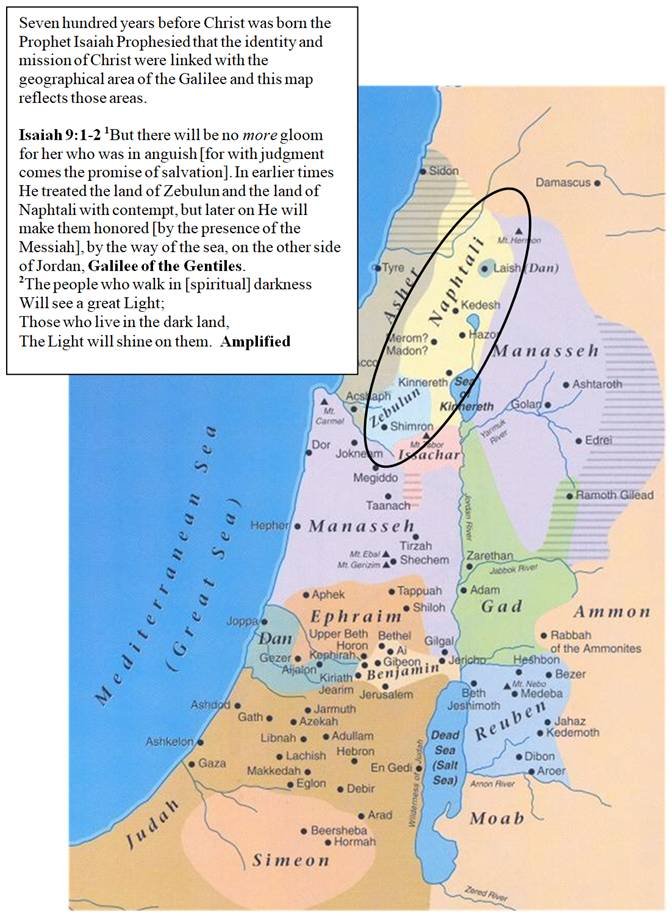
|
Christ’s Ministry in the Galilee of the Gentiles The below map shows some, but certainly not all of the events and miracles performed by Jesus during His ministry and time in the Galilee region. As the Apostle John wrote:
John 21:25 “Jesus did many other things as well. If every one of them were written down, I suppose that even the whole world would not have room for the books that would be written.” (NIV) |
|
|
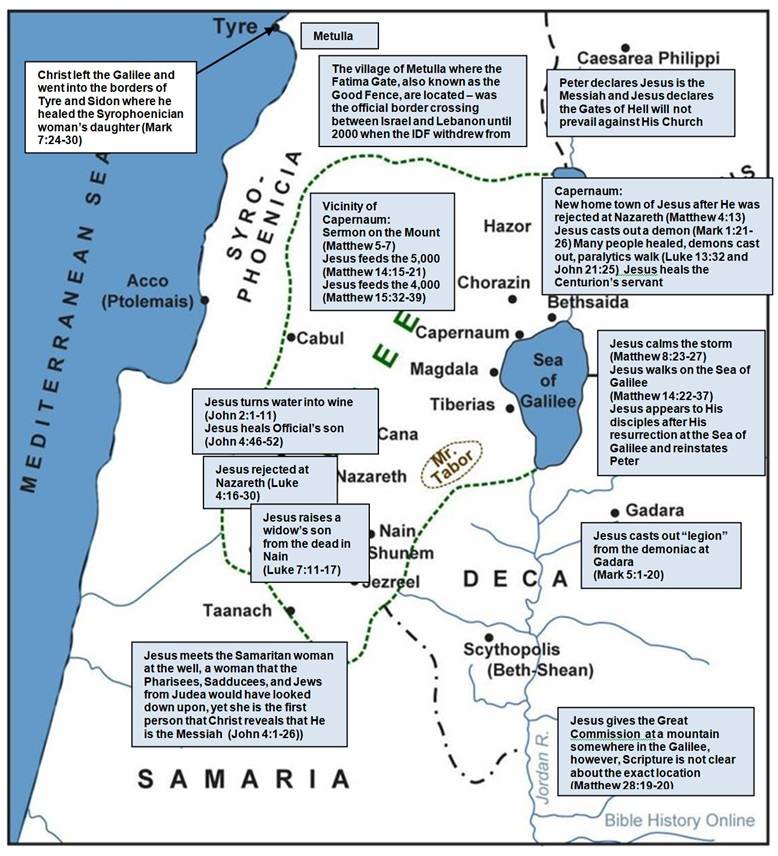
|
The “Fatima Gate,” also known as the Good Fence Border Crossing, and the Gates of Hell |
|
|
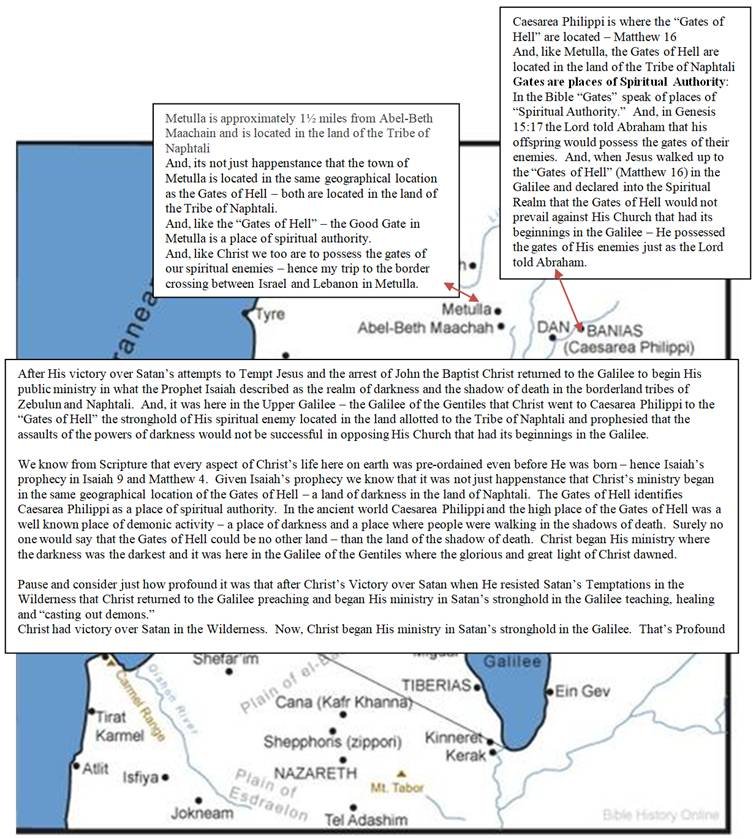
|
Then and Now: From the Galilee to the Entire World The Great Light of Jesus Christ first seen by those living in the darkness of the Galilee is still seen today
The light of Jesus Christ continues to shine in the darkness, and the darkness can never extinguish it.
Connecting the Dots: In Matthew 4:12-17 Matthew connected the dots between Isaiah 9:1-2 to Jesus’ life and ministry in the Galilee for us so that we could grasp the bigger picture and understand God’s plan for all of mankind – not just that of the Jewish people, but the Gentiles as well. By connecting the dots for us between Isaiah’s prophecy and the life of Christ we are able to understand the relevance between the great light that Isaiah spoke of 700 years before Christ was born – that those walking in darkness would see a great light with the words of Christ who said “I AM the light of the world: he that followeth Me shall not walk in darkness, but shall have the light of life.”
Jesus Christ, the Great Light of the World was first seen in the Galilee where the Gates of Hell were located in Caesarea Philippi.
John 8:12 12 Then spake Jesus again unto them, saying, I am the light of the world: he that followeth Me shall not walk in darkness, but shall have the light of life. 13 The Pharisees therefore said unto him, Thou bearest record of thyself; thy record is not true. KJV
Matthew 4:12-16 12 Now when Jesus had heard that John was cast into prison, he departed into Galilee; 13 And leaving Nazareth, he came and dwelt in Capernaum, which is upon the sea coast, in the borders of Zabulon and Nephthalim: 14 That it might be fulfilled which was spoken by Esaias the prophet, saying, 15 The land of Zabulon, and the land of Nephthalim, by the way of the sea, beyond Jordan, Galilee of the Gentiles; 16 The people which sat in darkness saw great light; and to them which sat in the region and shadow of death light is sprung up. KJV
Scripture Interprets Scripture: When we connect the dots between Isaiah 9:1-2 and Matthew 4:12-16 we are able to correctly discern how events in the past are connected to events that happen in our own lifetime from a spiritual and eternal perspective. For example, the relationship between George Otis and Major Haddad (the founder of the South Lebanon Army) and the birth of the “The Voice of Hope” (on the war-torn battlefield of Lebanon) and the “Historic Maritime Agreement” (on October 11, 2022) between Israel and Lebanon who share a border in the “Galilee of the Gentiles.”
The “Voice of Hope” that is now heard on every continent of the world brought the Great Light of Jesus Christ to everything that God created even though the darkness has not understood it because of Satan, our spiritual enemy who has blinded those who don’t believe. However, the darkness of Satan can never extinguish the great light of Jesus Christ from those who do believe.
2 Corinthians 4:3-4 3
If the Good News we preach is hidden behind a veil, it is hidden only
from people who are perishing. 4 Satan, who is the god of this
world, has blinded the minds of those who don’t believe. They are unable to
see the glorious light of the Good News. They don’t understand this message
about the glory of Christ, who is the exact likeness of God. NLT John 1:4-5 4 The
Word gave life to everything that was created, and his life brought light to
everyone. Those to first witness the great light of Jesus Christ were those living in darkness in the Galilee – the geographical regions where Jesus lived and ministered. From the time those living in the Galilee first saw the great light of Christ the “Great I AM – the Light of the World – the world has not been the same!
It all Began on the First Day of Creation when God Separated Light from the Darkness (Genesis 1:3-4): Ecclesiastes 1:9 teaches that History merely repeats itself that nothing under the sun is truly new – what has been will be again – our past is prologue to our future. And, that holds true for Jesus Christ – who said “I AM the Light of the World” – the Light that those living in the Galilee were the first to witness.
We can connect the dots of Jesus Christ as the “Light of the World” from the Beginning of Creation (Genesis 1) to the Light in New Jerusalem (Revelation 21).
Jesus Christ, the “Light of the World,” is the Alpha and Omega of Light Beginning with Creation and Ending with the New Jerusalem
When we connect the dots it becomes obvious that the Great Light that those living in the darkness of the Galilee saw was seen at the beginning of the world when it was created and is the Light of the New Jerusalem that will shine so brightly that neither the sun or moon need exist.
Genesis 1:1-5 1 In the beginning God created the heavens and the earth. 2 Now the earth was formless and empty, darkness covered the surface of the watery depths, and the Spirit of God was hovering over the surface of the waters. 3 Then God said, “Let there be light,” and there was light. 4 God saw that the light was good, and God separated the light from the darkness. 5 God called the light “day,” and He called the darkness “night.” Evening came and then morning: the first day. HCSB
We know from Hebrews 1:1-19 that Christ created and sustains the world. And, the Apostle John reveals that God sent John the Baptist to tell the world about the Light – about Jesus the true light who gives light to everyone, that Jesus, the true light, was coming into the very world that He created. John 3:19; John 12:46
John 1:1-10 1 In the beginning the Word already existed. The Word was with God, and the Word was God. 2 He existed in the beginning with God. 3 God created everything through Him, and nothing was created except through Him. 4 The Word gave life to everything that was created, and His life brought light to everyone. 5 The light shines in the darkness, and the darkness can never extinguish it. 6 God sent a man, John the Baptist, 7 to tell about the light so that everyone might believe because of his testimony. 8 John himself was not the light; he was simply a witness to tell about the light. 9 The one who is the true light, who gives light to everyone, was coming into the world. 10 He came into the very world he created, but the world didn’t recognize him. NLT
Colossians 1:15-16 15 Christ is the visible image of the invisible God. He existed before anything was created and is supreme over all creation, 16 for through Him God created everything in the heavenly realms and on earth. He made the things we can see and the things we can’t see— such as thrones, kingdoms, rulers, and authorities in the unseen world. Everything was created through Him and for Him. NLT
The Book of Genesis is known as the Book of beginnings – the beginning of creation – the beginning of the great light that those living in the Galilee would eventually see. The Book of Revelation gives us the finality of everything that was created including the great light that those living in Galilee saw – the great light of Jesus Christ who said “I AM the light of the world” that will shine so brightly in the New Jerusalem that there will be no need of either the sun or moon.
Jesus Christ the Lamb of God is the Light of New Jerusalem:
Revelation 21:22-24 22 I saw no temple in the city, for the Lord God Almighty and the Lamb are its temple. 23 And the city has no need of sun or moon, for the glory of God illuminates the city, and the Lamb is its light. 24 The nations will walk in its light, and the kings of the world will enter the city in all their glory. NLT
Elijah as well as Peter, James and John saw the great light of Jesus Christ that was present when light was separated from the darkness in Genesis 1 and the light of Christ that will be the light that will illuminate the New Jerusalem at the Transfiguration of Jesus Christ
Matthew 17:1-2 1 Now after six days Jesus took Peter, James, and John his brother, led them up on a high mountain by themselves; 2 and He was transfigured before them. His face shone like the sun, and His clothes became as white as the light. 3 Suddenly, Moses and Elijah appeared to them, talking with Him. NKJV
The light of Genesis 1 was a physical manifestation of Christ’s glory on the first day of creation and will once again manifest in the New Jerusalem – as Christ’s glory will once again manifest as the light of the New Jerusalem.
Genesis 1:4 reveals that God separated light from darkness” and this message of separating light from darkness is echoed in 2 Corinthians 6:14
2 Corinthians 6:14 14 Do not be unequally yoked together with unbelievers. For what fellowship has righteousness with lawlessness? And what communion has light with darkness? NKJV
What communion has light with darkness? What part hath the Believer with an Unbeliever?
The separation of light from darkness begins in Genesis 1:4 and echoes throughout Scripture. In the Book of Revelation the Apostle John reveals that because of the light of Christ that will manifest in the New Jerusalem there will be no night, and no darkness. In other words, there will be no sin, and no sinners, from which saints must separate themselves.
Our Past is Prologue to our Future
We know from Ecclesiastes 1:9-10 that the Past is Prologue to the Future and that certainly holds true for those living in Metulla and the Borderland today. Following is just one example of how Isaiah’s prophecy regarding Metulla and the “Borderlands” of the “Galilee of the Gentiles” is still relevant in the lives of the people currently living in Metulla and in the vicinity of the “Galilee of the Gentiles.”
Given that the Israeli border town of Metulla, at one time, was a Lebanese village and that Lebanon has always maintained that this particular Israeli town belongs within Lebanon territory it’s ironic that the International Community (Gentile nations) would choose the Israeli border town of Metulla to serve as the official northern border of the State of Israel which would also serve as the Official Border between northern Israel and southern Lebanon in the Borderlands of the Galilee of the Gentiles (Isaiah 9:1-2)
Given Isaiah’s Prophecy concerning the “Galilee of the Gentiles” it’s obvious that it was not just happenstance that the Gentile nations of France, England and the United Nations were the ones to determine where the border should be between the Jewish nation of Israel and the Gentile nation of Lebanon.
Before examining Metulla’s history from 1571 up to the present time (2022) I want to point out that some of the people living in the Galilee of the Gentiles during the Assyrian invasion (721 B.C.) would have been among those taken into captivity by the Assyrians.
We know from 2 Kings 15:29 that when the Assyrians invaded the Galilee of the Gentiles in the land of Naphtali the town of “Abel-beth-maach” was among the many towns the Assyrians captured and deported those living there to Assyria. I mention “Abel-beth-maach” because present-day Metulla is only 1½ miles from the Biblical town of Abel-Beth-Maacah that belonged to the Tribe of Naphtali.
The account of Abel Beth Maacah is found in 2 Samuel 20:1-22; 1 Kings 15:20 and 2 Kings 15:29.
2 Kings 15:29 29 In the days of Pekah king of Israel came Tiglath-pileser king of Assyria, and took Ijon, and Abel-beth-maacah, and Janoah, and Kedesh, and Hazor, and Gilead, and Galilee, all the land of Naphtali; and he carried them captive to Assyria. ASV
Given that present-day Metulla is located only 1½ miles from the Biblical town of “Abel-Beth-Maacah” the people who lived in what is now modern-day Metulla would undoubtedly have lived within the fortified town of Abel-Beth-Maacah the town that belonged to the lands of “Naphtali” (Isaiah 9:1-2) that Isaiah spoke of. Not only would the people of ancient Metulla have been taken into captivity – the offspring of those who the Assyrians left (or whose offspring later returned) would have been among those who were the first to see the great and glorious light of Christ Jesus as prophesied by Isaiah.
The offspring of the Galileans living in what is now modern-day Metulla located along the border of Lebanon in the “Galilee of the Gentiles” (Upper Galilee) would have been among the first Galileans to be filled with the Glory of the Lord. Isaiah 9:1 and Matthew 4:12-17.
And, without a doubt Isaiah’s Prophecy (Isaiah 9:1-2) has a Bearing on all that is currently happening in present-day Metulla and the Borderlands of the Galilee. Therefore, I want to examine the events that have occurred at the Borderland of the Galilee of the Gentiles beginning with 1517 through 2022, the year when Israel and Lebanon signed the Historic Maritime Agreement. The agreement was historic for a number of reasons and one of those reasons is that for the first time in their history since Israel gained their independence in 1948/49 Lebanon was forced to acknowledge that there was a border that existed at the Borderland, albeit a Maritime Border.
1896-2022: After reflecting on the Biblical history of the Galilee going all the way back to Isaiah’s prophecy (Isaiah 9:1-2) and the period when the Assyrians invaded the Galilee as outlined above – to understand how Isaiah’s Prophecy is relevant in today’s world specifically “Metulla” and the “Galilee of the Gentiles” I want to now examine the events that have occurred in Metulla starting with 1897 through October 2022 when Israel and Lebanon signed the Historic Maritime Agreement.
Again, according to Ecclesiastes 1:9-10 the Past is Prologue to the Future so to understand how Isaiah’s Prophecy is relevant to “Metulla” Israel’s most northern town that is located in the “Galilee of the Gentiles” that shares a border with Lebanon we have already examined the Northern Ten Tribes of Israel in the Galilee from a Biblical perspective – now we need to examine the region of the Galilee starting with 1571-1917 to the present-day of 2022 when Israel and Lebanon signed the “Historic Maritime Agreement.”
Metulla Timeline
1517-1917 - The Ottoman Empire: From 1517 until 1917 Galilee along with Jerusalem and other parts of the Promised Land, including the Galilee of the Gentiles and Mettula were governed by the Ottoman Empire.
1896 – The Druze Rebellion: During the Ottoman Empire’s reign – Metulla was a Druze village whose owner was an Arab Christian from Tyre/Sidon, Lebanon. After the outbreak of the Druze Rebellion, the owner of Metulla sold the agricultural property to Baron de Rothschild, an ardent Zionist who made Metulla a Jewish settlement. After the Druze Rebellion ended the Druze tenants who worked the land before it was sold to Rothschild thought they could return to the land they had farmed only to find out they couldn’t return.
1916 – The Sykes-Picot Agreement: As explained in earlier chapters, the Sykes-Picot Agreement was a secret negotiated settlement between England and France that was made in anticipation of the fall of the Ottoman Empire. The agreement was purposely vague and modified several times, but determined the general territories and responsibilities, later called “mandates,” of the Middle Eastern countries that were part of the Ottoman Empire and were drawn up in accordance with political and colonial ambitions of England and France, rather than taking into consideration historical and tribal issues of the local areas. The English Mandate of Palestine included the modern country of Israel, while the French Mandate of Syria included modern-day Lebanon, parts of which were later transferred to the English Mandate, such as Metulla.
1917 – The Collapse of the Ottoman Empire: Near the end of World War I, Metulla was annexed to the area governed by the French Mandate which included modern-day Lebanon.
1918 – World War I ends: On November 11, 1918, the Armistice is signed thus officially ending World War I.
1924 – The Annexation of the British Mandate: In 1924 Metulla was removed from the authority of the French Mandate and was annexed to the area governed by the British mandate whose jurisdiction included Jerusalem and all the Promised Land. Needless to say, Lebanon was not happy about this and to this day claim that Metulla belongs within the jurisdiction of Lebanon. This is one of the reasons Lebanon will not recognize Metulla as the “land border” between northern Israel and southern Lebanon as legitimate, which has led to many conflicts between Lebanon and Israel.
1948/49 – Israeli Independence: At the end of the British Mandate on June 15, 1948 when Israel gained their independence from Britain, Metulla remained inside the northern border of Israel in the Galilee of the Gentiles and then was under the authority of the new state of Israel where it remains today.
Given that the Israeli border town of Metulla at one time was a Lebanese village and that Lebanon has always maintained that this particular Israeli town belongs within Lebanese Territory, it’s ironic that the International Community (Gentile nations) would chose the Israeli border town of Metulla to serve as the official northern border of the State of Israel which would also serve as the Official Border between northern Israel and southern Lebanon in the Borderlands of the Galilee of the Gentiles (Isaiah 9:1-2)
And, therein lies a problem that has yet to be resolved between Israel and Lebanon. To this day Lebanon will not accept Metulla as the northern border of Israel because they believe that Metulla belongs to Lebanon, therefore, they believe Metulla should be within their borders. And, this is one of the main reasons that Lebanon remains unofficially at war with Israel.
What added fuel to the fire was when Israel became a nation in 1948 the border between the two nations became a major issue for Lebanon. Until then the citizens living on both sides of the border were at peace with one another. However, it was the interference of both the French and British in having any say as to where the borders in the Middle East should have been drawn at the end of World War I that caused the problem.
Given Isaiah’s Prophecy concerning the “Galilee of the Gentiles” it’s obvious that it was not just happenstance that the Gentile nations of France, England and the United Nations were the ones to determine where the border should be between the Jewish nation of Israel and the Gentile nation of Lebanon.
The IDF & SLA Join Forces to Protect the Borderlands in the Upper Galilee including Metulla, the Official Border Crossing.
1982-2000: The Border War and Metulla Border Crossing: From 1982-2000 the IDF and the SLA joined forces to Protect the Borderland in the Galilee of the Gentiles. The unity between the Jewish IDF (Israel Defense Forces) and the Christian SLA (South Lebanon Army) was not something the PLO or Hezbollah could ever have imagined. Yet, it was the 1982-2000 Conflict between Israel and Lebanon at the Borderland of the Galilee of the Gentiles that God used to bring down the Walls of Hostility between the Jews and Gentiles – Ephesians 2:14-18.
First the PLO then Hezbollah, both terrorist groups who were determined to make the lives of those living in Metulla miserable, set up strongholds just inside Lebanon’s border where they could launch rockets into Metulla and northern Israel. And, northern Israel was not their only target. They hated the Christians living inside Lebanon, particularly the South Lebanon Army, a Christian Militia whose hearts were turned towards the Jewish people living in Metulla and the northern Galilee.
And, it was the nonstop attacks of the PLO then Hezbollah at the Border that brought the Israel Defense Forces and the South Lebanon Army, a Christian Militia, together as one.
It was here at the Broader Land that Israel shares with Lebanon that the Lord used the Conflict between Lebanon and Israel to bring down the walls of hostility between the Jew and Gentile. In their efforts to help the IDF defend their northern border from the attacks of Hezbollah that had set up a stronghold in Lebanon, the SLA allowed the IDF to maintain a “Security Zone” inside the Border of Lebanon from 1982 -2000.
It was here at the Borderland of the “Galilee of the Gentiles,” at the “Good Fence,” the Official Border Crossing between Northern Israel in Upper Galilee and Lebanon within walking distance of the town of Metulla, Israel’s most northern town, that the Lord brought down the Walls of Hostility Between the Jews and Lebanon’s Christian Militia. The IDF and the SLA formed a brotherhood at the Borderlands in the “Galilee of the Gentiles” where terrorists were attacking both sides of the border.
The Good Fence/Fatima Gate, located within walking distance of Metulla, is the Fence that separates Israel from Lebanon and is the Official Border Crossing between Israel and Lebanon. The “Good Fence” is the Border Crossing that the IDF, George Otis, Lebanese Major Haddad, and everyday citizens of both Lebanon and Israel used to go back and forth between Israel and Lebanon from 1982 until 2000 (when the IDF withdrew from the Security Zone in Lebanon and the “Good Fence” Border Crossing was locked).
2000: IDF Withdrawal from the Security Zone: When the IDF withdrew from Lebanon back into the “Galilee of the Gentiles” several thousand Lebanese who were soldiers in the South Lebanese Army along with their families crossed over from Lebanon into Metulla; otherwise, they would have been killed at the hands of Hezbollah if they stayed in Lebanon.
In other words, this is just one more example of Gentiles living alongside the Israelis at the Borderland in Upper Galilee that the Prophet Isaiah spoke of in Isaiah 9:1-2.
Since 2000 the IDF has installed an upgraded security fence to protect Metulla from the attacks of Hezbollah.
July 2021: Honoring the SLA in Metulla: In a historic ceremony Israel Honored the South Lebanese Army (SLA) the Lebanese Christian-dominated militia that fought alongside the IDF from 1982-2000 to protect Metulla and towns located in the “Galilee of the Gentiles” in Upper Galilee by erecting a Memorial to them near the “Good Fence/Gate” in the border town of Metulla.
For the first time in Israel’s History the “Yizkor Prayer,” a Prayer of Remembrance, was recited in Arabic on Israeli soil at the border Israel shares with Lebanon
Israel’s most Faithful Spiritual Allies are Christians: The SLA was founded by Major Haddad, a Christian, during the Lebanese Civil War and they remained a militia from 1977 until the IDF withdrew from Lebanon across the border back into Metulla, Israel in May 2000.
George Otis and the Borderlands in the Galilee of the Gentiles
George Otis’ Ministry in the Borderlands of the Galilee of the Gentiles: Before going to the events that occurred in 2018, more needs to be said about the ministry of George Otis at the Borderlands of the Galilee of the Gentiles. He was a remarkable man who, like King David, was a man after God’s own heart.
George Otis went to the Borderlands of the Galilee of the Gentiles and his story needs to be told because George Otis carried on the legacy of the “Great Commission” that the Lord gave to His Disciples when He met with them in the Galilee after His resurrection. The “Voice of Hope,” the radio station that broadcasts the Gospel of Jesus Christ to every continent of the world, was first heard on the war-torn battlefields of Lebanon from a radio station built and maintained by George Otis.
George Otis, a Christian Evangelist and founder of “High Adventure Ministries, went to Metulla in the Borderlands of the Galilee to meet with Major Haddad, founder of the South Lebanon Army, during the period of time when terrorists were attacking both sides of the border. When they met in Metulla, George Otis asked Major Haddad if there was anything he could do for him and the people of Lebanon. In response, Major Haddad asked if George could possibly provide him with a small radio transmitter so that he could keep in touch with the people in south Lebanon who were caught up in the midst of a civil war to encourage the people in his village to stay strong and not become discouraged. Much to Major Haddad’s surprise, the Lord placed it on George Otis’ heart to cross over the border in Metulla into Lebanon and build a “Christian Radio Station” on the war-torn battlefields of south Lebanon and broadcast the “Voice of Hope.” And today, the “Voice of Hope” – the Voice of the Gospel of Jesus Christ – is broadcast throughout every continent around the world. The “Voice of Hope” is in keeping with the “Great Commission.”
As a Disciple of Christ, George Otis was carrying on the legacy of Christ’s Disciples and the Great Commission to go into all the world and preach the Gospel of Christ.
Pause, and think about that! It was in the Galilee that the Lord gave the Great Commission; two thousand years later George Otis went to the Borderlands of the Galilee of the Gentiles and built a radio station that would take the Gospel of Jesus Christ to every continent in the world! And, the geographical aspect was not just happenstance.
Keep in mind that seven hundred years before Christ was born, the Prophet Isaiah Prophesied that the identity and mission of Christ were linked with the geographical area of Galilee, specifically the “Borderlands” of the Galilee of the Gentiles in Upper Galilee, the land of Zebulun and the land of Naphtali that God had held in contempt.
Even though there was war at the Border in the Galilee of the Gentiles George Otis was not afraid to go to the Borderlands and Cross over from Metulla, Israel into the war-torn battlefields of the Gentile nation of Lebanon
Christ sent word to His Disciples, “Be not Afraid” Go to the Galilee, the Borderland between Jews and Gentiles, between believers and unbelievers, between the godly and ungodly, and there they would meet Him.
Be not afraid of the borderland, for that is where we will see Him; that is where Christ told the Disciples they would see Him and that is where Church was born. The Resurrected Christ declared “Be not afraid and tell My disciples to go to Galilee; there they will see Me.”
I believe the resurrected Christ called out to George Otis: “Be not afraid. . . . Go to the Borderland of the Galilee. . . There you will see me.”
George Otis did not fear the impurity and the dangers of the Galilee of the Gentiles and its surroundings. Not only did he build a radio station that broadcast the “Voice of Hope, George Otis’ ministry also provided much needed food and clothing for the Lebanese people who were so downtrodden by the civil war raging all around them in their own country.
When Christ ministered to the Samaritan woman, the Roman Centurion, the ill, the demon-afflicted, or the Syrophoenician woman He met when He crossed over from Israel into the border of Tyre and Sidon and delivered her daughter from an evil spirit, He did not fear the impurity either. Instead, Christ brought down the dividing wall between the Jews and Gentiles, between the clean and the unclean.
Jesus did not do away with the Gateways of our Enemies at the Borders – He demands that we take possession of the gates of our enemies just as He did at the “Gates of Hell” when He went to Caesarea Philippi. God told Abraham, “your descendents shall possess the gate of their enemies.” And that’s what happened when Christ went to Caesarea Philippi – He took possession over the gate of His spiritual Enemy – Satan, that old ancient serpent. And, as the spiritual offspring of Abraham, we too are to possess the gates of our spiritual enemies. Like Christ, we too are Conquerors.
Genesis 22:17 17 blessing I will bless you, and multiplying I will multiply your descendants as the stars of the heaven and as the sand which is on the seashore; and your descendants shall possess the gate of their enemies. NKJV
And, that’s what George Otis did. Just as the Lord used George Otis to build a radio station on the war-torn battlefields of Lebanon and broadcast the “Voice of Hope,” Christ will use others to bring down the strongholds of the enemy at the border. Just as He used George Otis, Christ will use other Believers to bring about transformation at the Borderlands and bring down the dividing walls between Jews and Gentiles – between Believers and the Arab unbeliever.
The Spiritual Significance of the “Geographical” location of Metulla, Israel: And, that brings me back to the town of Metulla because Metulla is located in the “Galilee of the Gentiles” in the land of Naphtali, which the Prophet Isaiah spoke of in Isaiah 9:1-2. Whenever Major Haddad would meet with the IDF they would always meet in Metulla which meant that Major Haddad would have to cross from Lebanon into Israel through the Good Fence/Gate, which was the official border crossing in Metulla. The same held true for George Otis and his staff who manned the radio station in Lebanon – they would have to cross over into Lebanon through the “Good Fence/Gate.”
And, in May 2000, when the IDF withdrew from Lebanon back into Israel they crossed through the “Good Fence/Gate” in Metulla.
Which Begs the Question: Did Christ cross the Border at Metulla when He crossed over into the Borders of Tyre and Sidon? Mark 7:24
Understanding the geography of the world when Christ walked on earth is of the utmost importance in understanding the life of Jesus and how the geographical area of the “Borderlands of the Galilee – the Galilee of the Gentiles,” specifically the town of Metulla that shares their border with the gentile nation of Lebanon – is still relevant today. For example, when the IDF withdrew from Lebanon in 2000 back into Israel, they crossed from Lebanon back into Israel through the “Good Fence/Gate” that served as the Official Border and Border Crossing between Israel and Lebanon at that time.
And, because his radio station was in Lebanon, George Otis and those that were part of his ministry were constantly crossing over into Lebanon through the Official Border Crossing at the “Good Fence/Gate” located in Metulla – it begs the question: When Christ crossed over from Galilee into the borders of Tyre and Sidon (Lebanon) could the border crossing Christ crossed through have been located at the same geographical location of the border crossing (the Good Fence/Gate) that present-day Metulla shares with Lebanon?
Mark 7:24 24 And from thence He arose, and went into the borders of Tyre and Sidon, and entered into an house, and would have no man know it: but he could not be hid. KJV
Mark 7:24 24 Then Jesus left Galilee and went north to the region of Tyre. He didn’t want anyone to know which house he was staying in, but he couldn’t keep it a secret. NLT
Located only 1½ miles from Abel Beth Maachah, there is no doubt that present-day Metulla would have been part of Abel Beth Maachah.
Which begs the question: Could Christ have crossed over into the borders of Tyre and Sidon through Abel Beth Maachah, which included present-day Metulla?
The “Way of the Sea” According to Isaiah’s Prophecy
In his prophecy (Isaiah 9:1-2) one of the geographical areas that the Prophet Isaiah refers to is by the “Way of the Sea,” beyond Jordan, in Galilee of the Gentiles. The Prophet Isaiah calls it the “Way of the Sea,” not only because the Mediterranean Sea is the western border of Israel, however, the “Way of the Sea” was actually an ancient highway system that followed the Mediterranean coastline where one of its routes began north of Caesarea Philippi where the “Gates of Hell” are located all the way to the Mediterranean and Tyre. (As a note, on ancient maps “The Way of the Sea” was recorded as “Via Maris” – the Latin term for “Way of the Sea”).
Which begs the question: Again, did Christ cross over into the borders of Tyre and Sidon through Abel Beth Maachah which included present-day Metulla? |
|
Map 1 of 2 |
|
|
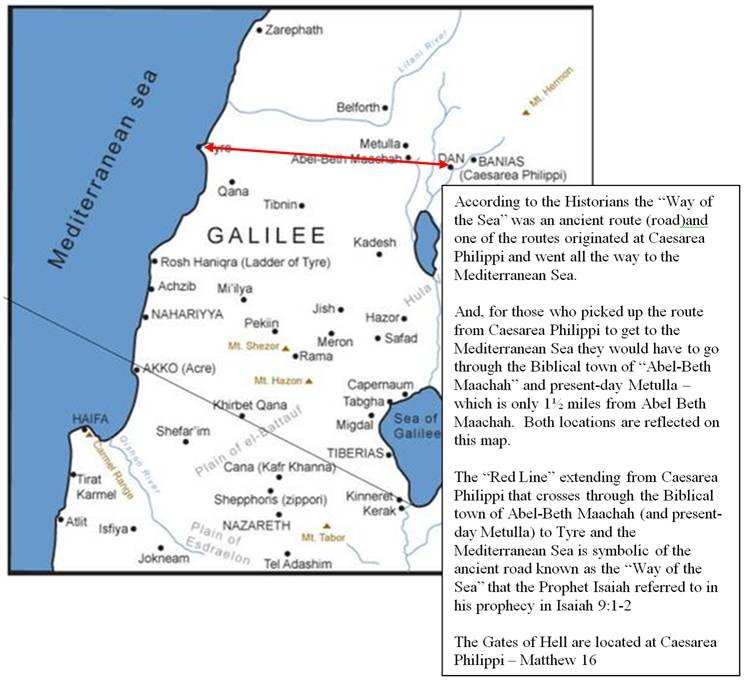
|
When Isaiah referenced by “Way of the Sea” he was speaking of the ancient highway and one of the routes ran from the Gates of Hell in Caesarea Philippi through Abel-Beth Maachan, located just 1½ miles from present-day Metulla, all the way to Tyre and Sidon and the Mediterranean Sea.
Pause and think about that! Even before Christ was born Isaiah Prophesied that Christ would go into the Borders of Tyre and Sidon where the Syrophoenicians that they too would see the Great and Glorious Light of Christ Jesus. The Syrophoenicians in the vicinity of Tyre and Sidon would be among the first to see the Great and Glorious Light of the Jesus Christ who said “I AM the Light of the World.” |
|
Map 2 of 2 |
|
|
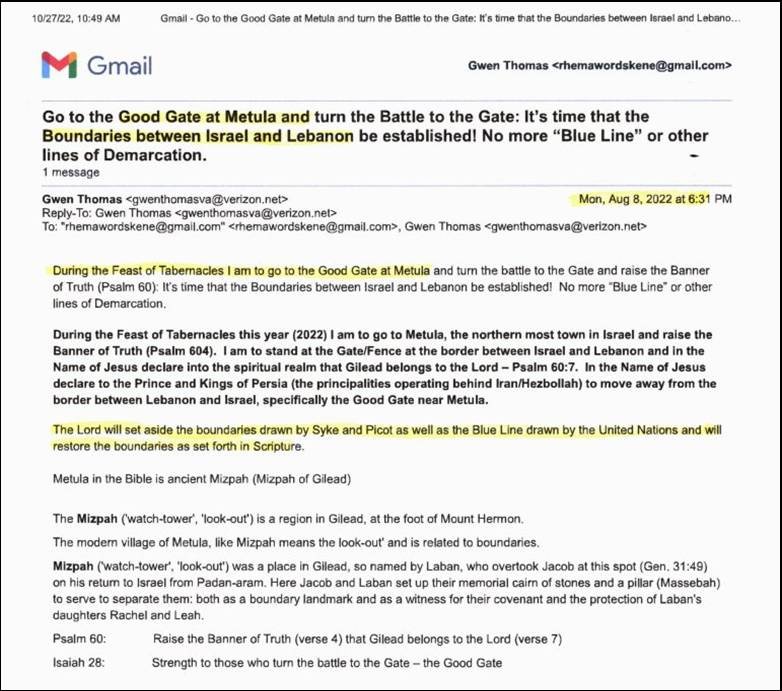
|
Mark 7:24 24 And from thence He arose, and went into the borders of Tyre and Sidon, and entered into an house, and would have no man know it: but he could not be hid. KJV
Mark 7:24 24 Then Jesus left Galilee and went north to the region of Tyre. He didn’t want anyone to know which house he was staying in, but he couldn’t keep it a secret. NLT
Did Christ cross over into the borders of Tyre and Sidon through Abel Beth Maachah which included present-day Metulla? I believe the answer is found in Isaiah’s Prophecy as recorded in Isaiah 9:1-2.
Historians cannot agree on what route Christ took when He crossed over into the regions of Tyre and Sidon. However, Isaiah’s prophecy in Isaiah 9:1-2 gives us a very good idea of where the border was that Christ crossed over into the regions of Tyre and Sidon.
In Isaiah 9:1-2, the Prophet Isaiah has the Assyrian invasion of the northern kingdom in mind. In the context of Isaiah 9:1-2, when Isaiah makes mention of by the “Way of the Sea” it is a reference to the highway that the Assyrians travelled on when they invaded northern Israel. From the perspective of the Assyrians, the region of Zebulun and Naphtali would be across the Jordan River on the way to the Mediterranean where the Assyrians invaded and took captive Israelites living in the northern towns of the Galilee, including Abel-Beth-Maachah, just 1½ miles from present-day Metulla.
Christ Lived in Capernaum which was Located on the Via Maris: We know that Christ left his hometown of Nazareth and went to Capernaum, which is profound because an ancient mile marker engraved with “Via Maris” was found in Capernaum, which was located by the “Way of the Sea.” This means that Christ literally lived on the “Way of the Sea,” one of the most important and well-known roads of the ancient world that passed through Galilee. In essence, the Way of the Sea can be thought of as a “Spiritual Highway.”
It can be likened to the importance of a street address. For example: it is common knowledge in America that 1600 Pennsylvania Avenue is the official address of the White House where the most powerful person in America lives (and some believe to be the most powerful individual in the world lives).
The Way of the Sea is a well documented route reflected on ancient maps as “Via Maris,” the Latin name for Way of the Sea. By living on the “Way of the Sea” (Via Maris), Jesus knew that the travelling merchants from the surrounding Gentile nations would hear or even witness firsthand His miracles and tell others they met on their travels all about Christ and the wonderful works He did for those walking in the shadows of death. The travelling merchants would take the Gospel of Jesus Christ back to their native countries via the “Way of the Sea” and in this way Christ’s message would spread far and wide to all the Gentile nations for whom His message was intended even before the beginning of time.
The Conversion of the Apostle Paul on the Road to Damascus: And, who can forget that when the Apostle Paul saw the Great and Glorious Light of Jesus Christ that the Prophet Isaiah spoke of, it was not in the Temple or the Synagogues in Jerusalem, but rather, it was on the “Way of the Sea” that the Prophet Isaiah spoke of (Acts 9:1-19).
How blessed the Apostle Paul was to be among the first to see the Great Light by the “Way of the Sea” that the prophet Isaiah spoke.
Paul’s conversion literally happened as Paul was travelling on the ancient trade route known as the Way of the Sea.” And, it was at this point in time that Christ revealed to Paul that he was being sent to take the Gospel of Jesus Christ to the Gentile nations.
Galatians 1:17-18 reveals that at his conversion Paul immediately went into Arabia, which is also located along the “Way of the Sea.” The point I want to make is Paul’s conversion on the “Way of the Sea” was not just happenstance,” nor was the fact that he immediately went into Arabia for approximately three years before he ever went back to Jerusalem.
Galatians 1:17 17I did not go up to Jerusalem to see those who were apostles before I was, but I went into Arabia. Later I returned to Damascus. NIV
See the following chapter for a more detailed account of the Road to Damascus.
It’s ironic that God used the ancient trade route that the Romans, who were oppressing the Jewish people, built for the spread of the Gospel of Jesus Christ throughout the world. God can use what was intended for evil for good (Romans 8).
There is so much depth in Isaiah’s Prophecy of Isaiah 9:1-2 concerning the Way of the Sea.
Capernaum was located about two miles west of the Jordan River and it became the center of His Galilean work and ministry. We know from Matthew 4:13-16 that Jesus began His Galilean ministry in the Galilee in fulfillment of Isaiah’s prophecy. And, in fulfilling Isaiah’s prophecy, Christ literally moved from Nazareth to Capernaum, which was located on the ancient road known as the “Way of the Sea” located beyond the Jordan.
The symbolism of Capernaum’s location on the “Way of the Sea” is profound because the “Way of the Sea” was the ancient route that connected three continents. Christ’s choice of Capernaum reveals what we already know from Scripture – His Gospel was to reach the entire Gentile world. And, that’s exactly what the “Voice of Hope” did: the Gospel of Jesus Christ now reaches every continent in the world. The radio station built by George Otis that carried the “Voice of Hope” was built on the war-torn battlefields of Lebanon just several miles from Tyre and Sidon. And, we know that the route that Christ took when He went into the Borders of Tyre and Sidon was probably the ancient highway by the “Way of the Sea.” It was not just happenstance that the Lord placed it on George Otis’ heart to build the radio station in Lebanon just across the border from Israel.
The way of the sea connected Israel to the Gentile World and this route would play an important role in the spread of the Gospel of Jesus Christ. Hence, when Jesus left the Galilee and went into the Borders of Tyre and Sidon and ministered to the Syrophoenician mother of her demon possessed daughter, He also took the Gospel. Mark 7:24-30.
The route that Christ would have taken when He crossed over into the Borders of Tyre and Sidon would have been on the ancient highway by the “Way of the Sea” – the same ancient highway He lived on.
In part Jeremiah 6:16 reads:
Jeremiah 6:16 16 Thus says the LORD: “Stand by the roads, and look, and ask for the ancient paths, where the good way is; and walk in it, and find rest for your souls. ESV ….. Which begs the question, “Is Via Maris – the “Way of the Sea,” one of those ancient paths?
It is well documented that for thousands of years travelers from different continents traveled along the Via Maris – the Way of the Sea – and in doing so they would have passed by Capernaum and this would have been the case in the days Jesus walked the earth.
The symbolism cannot be ignored. Christ’s ministry in the Galilee of the Gentiles located on the ancient highway that Isaiah spoke of by the “Way of the Sea” reveals that the Kingdom of God” extended beyond the borders of ancient Israel to the entire world in keeping with what the Lord told Abraham: “ALL NATIONS” would be blessed because of Abraham who, when God called him, was a Gentile.
The Prophet Isaiah prophesied that the people of the Galilee in the land of Zebulun and Naphtali by way of the sea would see a great light. And, that great and glorious light was the revelation of God that was formerly unknown to them that was brought to them by Jesus who said “I AM the Light of the World.” The Gospel of Jesus Christ is the revelation of God that was formerly unknown to them and they would be the first to receive this revelation.
Malachi 1:11 is also a fulfillment of Isaiah’s Prophecy:
Malachi Prophesied that the Gentiles would Magnify the Name of the Lord and we saw that come to pass in the Borderland of the Galilee of the Gentiles by the Way of the sea.
Malachi 1:1 reveals that when the Priests despised the Name of the Lord, God turned to the Gentiles who Magnified His Name. If the Priests thought that God would have no worshippers because they did not Magnify His Name they were wrong, for Malachi reveals that the Name of the Lord was magnified among the Gentiles, the very Gentiles the Priest looked down upon as detestable.
Malachi 1:11 For from the rising of the sun even unto the going down of the same My Name shall be great among the Gentiles; and in every place incense shall be offered unto My Name, and a pure offering: for My Name shall be great among the heathen, said the LORD of hosts. KJV
Back to the Timeline
2018: Cross-border Tunnels: In 2018 the IDF uncovered several cross-border tunnels that Hezbollah had built that extended from Lebanon underneath the border into Metulla. Instead of cross-border attacks on land, Hezbollah was planning on attacking Metulla within the town itself. The IDF believed that the goal of Hezbollah was to use the tunnels to cut the village of Metulla off from the south and after blocking Route 90, which is the main entry into Metulla; they would unleash their wrath on the Israelis living in Metulla that they believed had no right to live there. The goal of Hezbollah, a gentile terrorist organization, was to capture Metulla and the Galilee of the Gentiles.
Establishing a Boundary: The Historic Maritime Agreement
October 11, 2022: Israel and Lebanon sign the “Historic Maritime Agreement”: The Historic Maritime Agreement Israel and Lebanon signed on October 11, 2022 was a “Borderland” Agreement whose boundary was determined by Israel and Lebanon (not outside, foreign nations). Unlike the French and English who took it upon themselves to determine the boundary for both Lebanon and the Galilee of the Gentiles without any input from either Israel or Lebanon, this time both Israel and Lebanon’s voice were heard and triumphed over the voice of the Gentile nations of France, England, United States, and all others.
Having said that, we need to keep Ezekiel 27 in mind that tells us that Tyre was the Mighty Gateway to the Sea,” who established their own boundaries into the Sea.
I sent the following two emails to myself documenting that I was to go to Metulla during the Feast of Tabernacles and declare into the spiritual realm that God would establish a boundary between Israel and Lebanon, which is one of the reasons why I was at Metulla on the day Israel and Lebanon signed their historic maritime boundary agreement. The other reason was to declare into the spiritual realm for the principalities operating behind Hezbollah to move away from any attacks on Israel’s borders, specifically the northern town of Metulla.
When reading the email I sent to myself on August 8, 2022 we need to keep Ezekiel 27 in mind.
On August 8, 2022, no one knew “if” or “when” Lebanon and Israel would reach the agreement they reached on October 11, 2022. Obviously, I was not at the Good Fence/Border in the Borderlands of the “Galilee of the Gentiles” by happenstance.
In other words, in the spiritual realm something has shifted. A copy of the above mentioned emails of August 8, 2022 follow: |
|
|
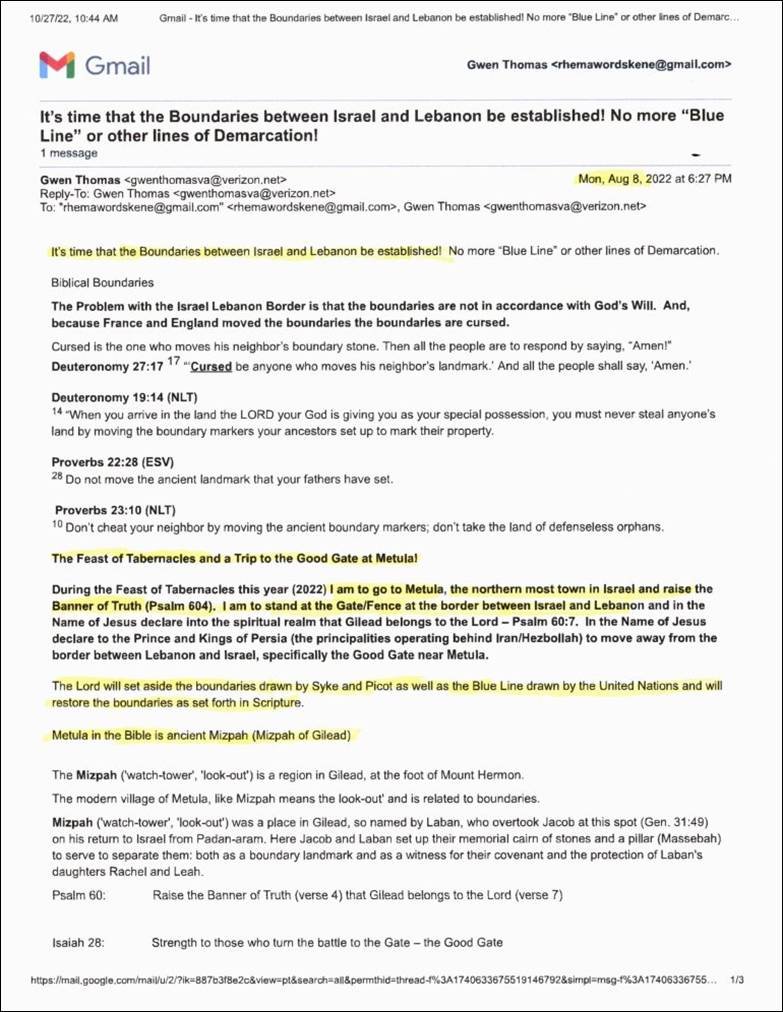
|
|
|
And, that’s why the Historic Maritime Agreement Israel and Lebanon signed on October 11, 2022 is of the utmost importance spiritually, as well as secularly. Likewise, Israel’s ongoing conflict with Lebanon regarding the land border between the two countries is also of the utmost importance. Lebanon believes that the town of Metulla rightly belongs to Lebanon. On the other hand, Israel believes that Metulla belongs to the Promised Land of Israel. Hence, Lebanon has never acknowledged the land border they share with Israel, and because of this, there have been many conflicts between the two nations and Lebanon maintains they are still officially at war.
Hopefully the time has come when both Israel and Lebanon, apart from the influence of Gentile nations outside the Middle East, can now determine between themselves where the land border is in the Galilee of the Gentiles.
History yet to be Written: It’s obvious that Isaiah’s Prophecy as recorded in Isaiah 9:1-2 is still relevant today. And, given that there is nothing new under the sun, that history only repeats itself, then we know that the Prophecy as recorded in Isaiah 9:1-2 will continue to have a bearing on the land border that both Israel and Lebanon have yet to establish in the Borderlands of the “Galilee of the Gentiles.” |